Product Overview
Transition pieces serve as the critical interface between the monopile foundation and the tower of an offshore wind turbine, transferring extreme loads from the turbine tower into the seabed. At Leading Top Union (领拓互联), transition pieces are manufactured in both conical and cylindrical configurations, engineered for grouted or bolted connections per DNV-GL-ST-0126 and IEC 61400-3 standards. The production facility in Suzhou handles units from 200 to 800 tons, with diameters spanning 4,000 to 9,000 mm and heights from 15 to 35 meters. Each transition piece is fabricated from normalized fine-grain structural steel S355NL or S420NL per EN 10025-3, ensuring excellent toughness at temperatures down to -40°C for North Sea and Baltic Sea deployments.
Precision Plate Rolling and Welding
The manufacturing process begins with precision plate rolling on 4-roller bending machines capable of forming steel up to 150 mm thickness. Longitudinal and circumferential welds are executed using submerged arc welding (SAW) and flux-cored arc welding (FCAW) processes, qualified under ISO 3834-2 and AWS D1.1. All welds undergo 100% ultrasonic testing (UT) per EN ISO 17640 and magnetic particle inspection (MPI) per EN ISO 17638. For critical full-penetration welds at the flange-to-shell connection, phased array ultrasonic testing (PAUT) is applied to detect planar defects as small as 2 mm. Post-weld heat treatment (PWHT) is performed in computer-controlled furnaces for stress relief when wall thickness exceeds 40 mm, per DNV-GL-CP-0287 requirements.
Flange Flatness and Machining Tolerances
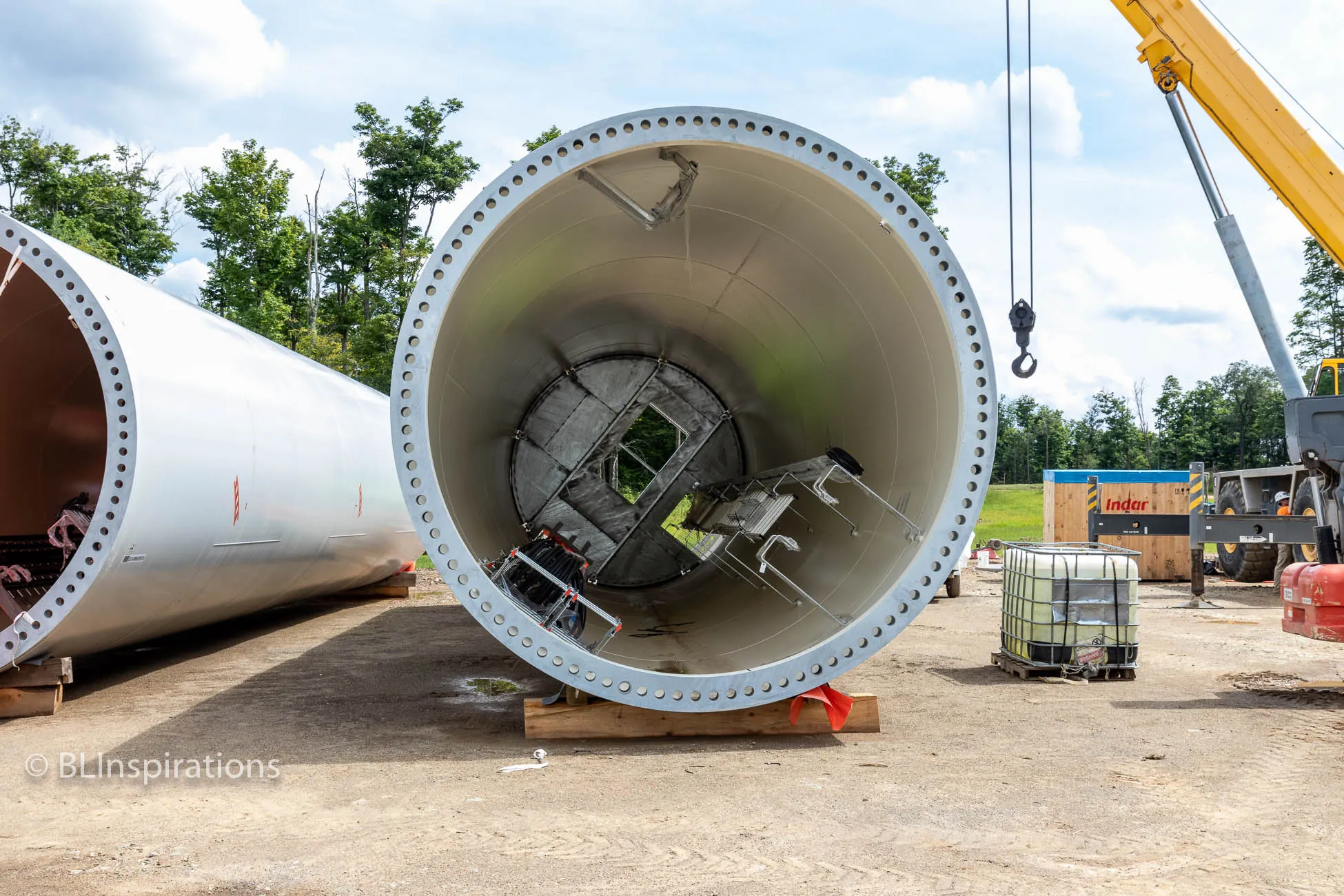
Flange flatness is a defining specification for transition piece performance, as out-of-tolerance flanges cause uneven load distribution and premature bolt fatigue. Flange flatness within 1 mm across the full diameter is achieved through a combination of stress-relieving, precision machining on 10-meter vertical boring mills, and final dimensional inspection using laser tracker systems with 0.02 mm accuracy. The flange face is machined to a surface roughness of Ra 3.2 μm or better, ensuring proper sealing for grouted connections and uniform preload distribution for bolted connections. Each flange is verified against EN 1090-2 EXC3 execution class requirements, with bolt hole patterns drilled to ±0.5 mm positional tolerance using CNC drilling templates.
Internal Platform and J-Tube Integration
Internal platform integration is performed during fabrication, not as a secondary operation, eliminating tolerance stack-up issues. Complete internal access systems are installed including ladders conforming to EN ISO 14122-4, intermediate platforms rated for 5 kN/m² live load, and cable tray supports designed to accommodate up to 48 submarine cables per J-tube. J-tube assemblies are prefabricated from seamless API 5L X65 pipe with bend radii of 5D to 8D, internally coated with fusion-bonded epoxy (FBE) for corrosion protection. The cable pull-in system includes bellmouth entry guides with 300 mm minimum radius, bend restrictors at 2-meter intervals, and pull-in wires pre-installed through each J-tube, reducing offshore installation time by up to 40% compared to field-installed systems.
Corrosion Protection for 25-Year Service Life
The coating system is designed for a 25-year design life in C5-M corrosion environments per ISO 12944-9. Surface preparation follows Sa 2.5 (near-white metal) blast cleaning per ISO 8501-1, with a surface profile of 75-125 μm measured per ISO 8503-2. The coating system comprises a zinc-rich epoxy primer at 60 μm DFT, a high-build epoxy intermediate coat at 200 μm DFT, and a polyurethane topcoat at 80 μm DFT, totaling 340 μm minimum dry film thickness. For splash zone areas, glass flake reinforced vinyl ester coatings are applied at 600 μm DFT, tested for impact resistance per ISO 6272 and cathodic disbondment per ASTM G8. All coated surfaces undergo holiday detection at 20 kV per NACE SP0188 and adhesion testing per ISO 4624 with minimum pull-off strength of 5 MPa.
Applications & Industries
Offshore wind energy remains the primary application for transition pieces, where they connect monopile foundations to turbine towers in water depths from 15 to 60 meters. For a typical 8 MW turbine with a 130-meter hub height, the transition piece must withstand ultimate loads exceeding 15,000 kN-m bending moment at the mudline and 8,000 kN shear force from wave and current loading. Designs incorporate fatigue detail categories per DNV-GL-RP-C203, with S-N curves based on 10 million cycles for welded joints in the splash zone. Transition pieces have been supplied for projects with 20-year fatigue life requirements and safety factors of 1.15 for ultimate limit state (ULS) and 1.0 for fatigue limit state (FLS) per IEC 61400-3.
Oil and Gas Subsea Applications
In the oil and gas sector, transition pieces are adapted for subsea template and manifold foundations, where they must withstand hydrocarbon exposure and potential fire scenarios. For these applications, fabrication uses ASTM A516 Grade 70 or EN 10028-3 P355NH steel with Charpy V-notch impact testing at -20°C per ASTM A370. The design incorporates J-tube pull-in systems for flexible flowlines and umbilicals, with bend restrictors rated for 50-year service life. Transition pieces for offshore platforms include integrated anode supports for sacrificial aluminum anodes per DNV-RP-B401, with anode mass calculated for 25-year protection at 1.5 A/m² current density in seawater. Boat landing structures are fabricated from S355J2+N steel per EN 10025-2, designed for 500 kN berthing loads and 200 kN mooring loads per ISO 21650.
Mining and Mineral Processing Adaptations
Mining and mineral processing applications use transition pieces as structural adaptors between processing plant foundations and heavy equipment such as gyratory crushers, ball mills, and vibrating screens. These units must withstand dynamic loads from rotating machinery with operating frequencies from 5 to 30 Hz, requiring natural frequency analysis to avoid resonance. Transition pieces are designed with integrated vibration isolation mounts and access platforms for routine maintenance. For a recent copper mine project in Chile, transition pieces weighing 450 tons each were supplied, fabricated from S420NL steel with 80 mm wall thickness, designed for 100-year seismic events per ASCE 7-16 with a seismic response coefficient of 0.3g.
Power Generation and Marine Applications
Power generation facilities, including thermal, nuclear, and concentrated solar power (CSP) plants, utilize transition pieces for steam turbine generator pedestals and cooling tower supports. These applications require strict control of differential settlement, with maximum angular distortion limited to 1/500 per ASCE 7-16. Transition pieces for power generation include integrated cable trays for high-voltage cables rated up to 33 kV, with cable ladder spacing at 600 mm centers per IEC 61537. For CSP plants with molten salt storage, transition pieces are fabricated from stainless steel clad carbon steel per ASTM A264, with the cladding layer of 316L stainless steel at 3 mm minimum thickness to resist corrosion from nitrate salt at 565°C operating temperature.
Shipbuilding and offshore marine applications require transition pieces for propulsion system foundations, thruster mounts, and deck equipment supports. These units must meet classification society rules from Lloyd's Register, DNV-GL, ABS, and Bureau Veritas. Fabrication uses shipbuilding grade steel such as DH36 and EH36 per ASTM A131, with Charpy V-notch testing at -20°C for unrestricted service. The transition pieces include integrated pipe penetrations for seawater cooling systems, with pipe sleeves welded to the shell and tested at 1.5 times design pressure per ASME B31.3. For a recent offshore support vessel project, transition pieces with 8-meter diameter, 20-meter height, and 350-ton weight were supplied, designed for dynamic positioning system foundations with 2 mm deflection tolerance under 1,000 kN thruster thrust.
Why Choose Leading Top Union for Transition Piece Manufacturing
Leading Top Union holds ISO 3834-2 certification for full quality management in welding, EN 1090-2 EXC3 for execution class 3 steel structures, and AWS D1.1 for structural welding. These certifications are audited annually by TÜV SÜD and Lloyd's Register, ensuring manufacturing processes meet the most stringent international standards. The quality management system is also certified to ISO 9001:2015 and ISO 14001:2015, with environmental controls for blast cleaning and coating operations. For each transition piece, a complete documentation package is provided including material test certificates per EN 10204 Type 3.1, welding procedure specifications (WPS) per ISO 15609-1, welder qualifications per ISO 9606-1, and non-destructive testing reports with defect location mapping.
Advanced Engineering Analysis and Validation
The engineering team performs detailed 3D finite element analysis (FEA) using ANSYS Workbench for each transition piece design, evaluating stress distribution under combined axial, bending, and torsional loads. Local stresses at flange-to-shell junctions, J-tube attachments, and platform support brackets are analyzed using submodeling techniques with element sizes down to 5 mm. Fatigue analysis follows the nominal stress approach per DNV-GL-RP-C203, with S-N curves for welded joints in seawater with cathodic protection. For bolted connections, bolt preload requirements are calculated per EN 1993-1-8, considering prying forces and slip resistance for preloaded bolts in oversized holes. All FEA results are validated against strain gauge measurements during factory acceptance testing, with correlation within 5% for critical locations.
Manufacturing Capabilities and Logistics
The Suzhou factory spans 120,000 square meters with dedicated production lines for transition piece manufacturing, including a 50-meter-long shot blast chamber, 12-meter-wide painting booth with temperature and humidity control, and a 500-ton lifting capacity gantry crane. Inventory of S355NL and S420NL plate is maintained in thicknesses from 20 mm to 150 mm, sourced from European mills with full EN 10204 Type 3.2 certification. For urgent projects, first article delivery can be achieved within 16 weeks from order placement, with serial production at a rate of one complete transition piece every 10 working days. The logistics team coordinates sea freight from Shanghai port to any global destination, with vessel chartering for oversized cargo exceeding 500 tons per piece.
Optional Inspection and Testing Services
Optional services include third-party inspection by DNV-GL, Bureau Veritas, or SGS, with witness points for material receiving, welding, NDT, dimensional inspection, and coating. Factory acceptance testing (FAT) includes full dimensional inspection using laser scanning with 3D model comparison, flange flatness verification using feeler gauges and straightedges, and bolt hole pattern verification using go/no-go gauges. For grouted connection designs, grout annulus simulation tests are performed to verify grout flow and venting. For bolted connection designs, bolt preload verification is conducted using hydraulic tensioners with load cells. All test results are documented in a FAT report that serves as the basis for offshore installation acceptance.