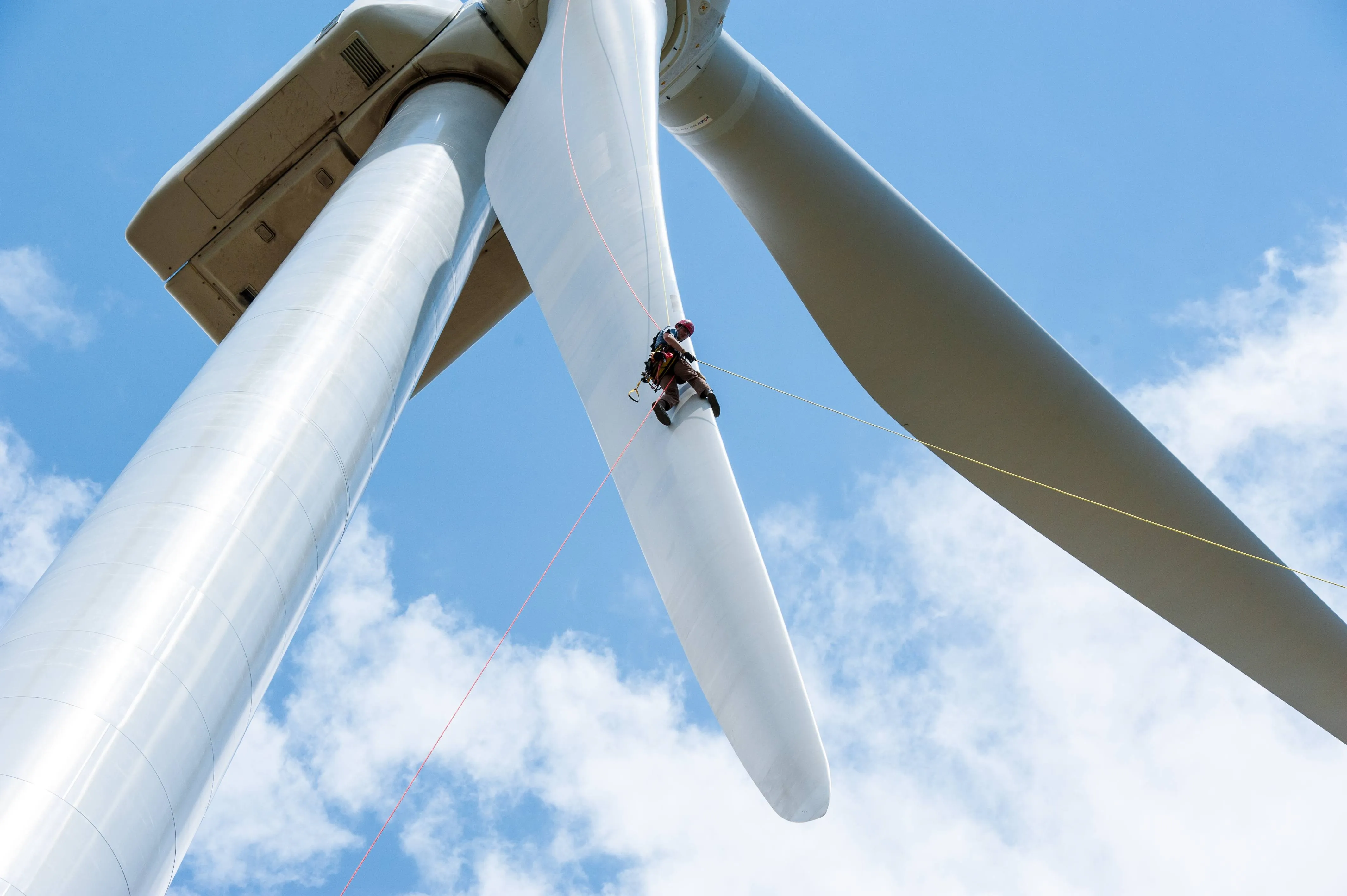
Monopile Foundation Fabrication
Heavy steel monopile foundation fabrication for offshore wind turbines. We manufacture monopiles up to 12m diameter and 100m length with wall thickness up to 150mm, meeting the strictest offshore structural standards.
Heavy steel monopile foundation fabrication for offshore wind turbines. We manufacture monopiles up to 12m diameter and 100m length with wall thickness up to 150mm, meeting the strictest offshore structural standards.
EN 1090-2 EXC3/EXC4
Single Piece up to 80T
NDT 100% Inspection
Offshore Grade
Monopile foundations serve as the primary load-bearing substructure for offshore wind turbines, transferring dynamic and static loads from the tower and rotor-nacelle assembly into the seabed. Leading Top Union fabricates these critical components from 4,000 mm to 12,000 mm in diameter with wall thicknesses ranging from 40 mm to 150 mm, using S355, S420, and S460 steel grades per EN 10025-2. Each monopile undergoes submerged arc welding (SAW) for both longitudinal and circumferential seams, with weld parameters controlled to maintain heat input between 1.5 kJ/mm and 3.0 kJ/mm depending on plate thickness, ensuring consistent mechanical properties across the full 100-meter segmented length.
The fabrication process begins with plate edge preparation using CNC bevelling machines capable of achieving ±0.5 mm accuracy on bevel angles from 30° to 45°, followed by cold forming on three-roll bending machines with 2,000-ton capacity. After tack welding, longitudinal seams are welded using twin-wire SAW at travel speeds of 400-600 mm/min, achieving deposition rates up to 15 kg/hour per wire. Circumferential girth welds are completed using column-and-boom SAW systems with programmable rotation tables, maintaining interpass temperatures between 150°C and 250°C as specified in EN 1011-2 for S460 grade material. All welding procedures are qualified under EN ISO 15614-1 with impact testing at -40°C for offshore applications.
Post-weld heat treatment (PWHT) is applied when wall thickness exceeds 50 mm for S460 grades, using programmable electric resistance furnaces with temperature uniformity within ±15°C across the entire monopile section. Dimensional control during fabrication relies on laser scanning systems that measure roundness at 1-meter intervals along the length, achieving tolerances within 0.5% of nominal diameter as required by DNV-ST-0126. For a 10,000 mm diameter monopile, this means maximum ovality of 50 mm. End perpendicularity is held to ±1 mm per meter of diameter, critical for flange connections in transition piece assembly. Each monopile receives a unique identification number with full traceability from mill certificate to final inspection report.
Corrosion protection for monopile foundations is engineered for a 25-year design life in C5-M marine environments per ISO 12944-9. The coating system comprises a three-layer epoxy glass-flake system applied at 600-800 microns dry film thickness, with zinc-rich primer for cathodic protection compatibility. For internal surfaces, a 400-micron high-build epoxy coating is applied with slip resistance coefficient above 0.5 per ISO 14122-2. All coating applications occur in climate-controlled bays maintaining 20°C ±3°C and relative humidity below 60%, with surface preparation to Sa 2.5 per ISO 8501-1 using steel grit with hardness above 50 HRC. Holiday detection is performed at 100% coverage using 15,000-volt DC spark testing per NACE SP0188.
Non-destructive testing follows a comprehensive protocol exceeding standard requirements. All SAW welds undergo 100% ultrasonic testing (UT) using phased array technology with 64-element probes operating at 5 MHz, achieving detection sensitivity for planar defects down to 2 mm equivalent reflector size. Radiographic testing (RT) is performed on 100% of welds using digital detectors with 200 kV X-ray sources, providing immediate image analysis with contrast sensitivity better than 1.5% per ASTM E2597. Additional NDT includes magnetic particle inspection (MPI) on all weld caps and root passes, plus hardness testing per ISO 6508-1 with maximum 350 HV10 for HAZ areas. NDT technicians hold Level II or III certifications per ISO 9712.
Monopile foundations are the dominant substructure type for offshore wind farms in water depths from 10 meters to 40 meters, representing over 80% of installed offshore wind foundations globally according to WindEurope data. Leading Top Union supplies monopiles for projects in the North Sea, Baltic Sea, and Asia-Pacific regions, where soil conditions range from dense sand to stiff clay with undrained shear strengths up to 250 kPa. These monopiles are designed to withstand ultimate limit state loads including 50-year wave heights exceeding 15 meters and 1-hour mean wind speeds of 45 m/s at hub height, with fatigue life calculated per DNV-RP-C203 for 10^7 to 10^8 load cycles over the 25-year operational life.
Beyond offshore wind, monopile structures serve as foundations for offshore substation platforms, met masts, and oil and gas production riser supports. For oil and gas applications, monopiles are fabricated to API 2B and API 2W specifications with additional Charpy V-notch impact testing at -20°C for jacket structures in the Gulf of Mexico and North Sea. Wall thicknesses up to 150 mm accommodate the higher bending moments from topside loads exceeding 5,000 tonnes, with pile diameters of 6,000 mm to 8,000 mm common for four-pile jacket configurations. ISO 3834-2 certification ensures weld quality meets the stringent requirements of NORSOK M-101 for Norwegian continental shelf projects.
In the mining industry, monopile foundations are increasingly specified for conveyor support structures and ore handling facilities in coastal and riverine environments. Fabrication capabilities support diameters from 4,000 mm to 8,000 mm with wall thicknesses optimized for abrasive wear resistance, using S420 steel with additional hardness requirements of 200-250 HB. For power generation applications, including thermal and nuclear plants, monopile foundations for cooling water intake structures require precise dimensional control for mating with prefabricated pipe sections. Concentricity tolerances within 3 mm across 20-meter sections are achieved, enabling direct bolted connections without field rework, reducing installation time by up to 30% compared to traditional grouted connections.
Shipbuilding and offshore marine applications utilize monopile structures as mooring dolphins, breasting dolphins, and fender support piles at deepwater ports. EN 1090-2 EXC4 execution class certification covers the fabrication of these structures with fatigue detail categories up to FAT 125 per EN 1993-1-9, essential for structures subject to continuous vessel impact loads. For projects requiring cathodic protection integration, aluminum-zinc-indium sacrificial anodes weighing 150-300 kg each are installed at 5-meter intervals, with weld attachments qualified per DNV-RP-B401. The annual capacity of 50,000 tonnes allows delivery of complete monopile sets for 50-60 wind turbines per year, or equivalent tonnage for industrial foundation projects.
Leading Top Union operates a dedicated monopile production facility in Suzhou with 25,000 square meters of covered fabrication space, equipped with 12 overhead cranes rated from 50 to 200 tonnes capacity. The production line includes three 4-roll plate bending machines capable of forming plate widths up to 4,500 mm and thicknesses up to 150 mm, with CNC control achieving bending accuracy within ±1 mm across the plate width. The facility maintains ISO 3834-2 certification for full quality management of welding processes, with 15 certified welding engineers and 120 qualified welders holding certifications per EN 287-1 for all positional welds in thicknesses up to 150 mm.
The quality management system integrates real-time monitoring of welding parameters through a central data acquisition system that records voltage, current, travel speed, and interpass temperature for every weld pass. This data is stored for the full project lifecycle and provided to clients as part of the weld traceability package, which includes weld maps, NDT reports, and material test certificates. ISO 9001:2015 certification is maintained with annual surveillance audits, and the NDT laboratory is accredited per ISO 17025 for UT, RT, MPI, and PT methods. For projects requiring third-party inspection, coordination with DNV, Bureau Veritas, Lloyd's Register, or client-appointed inspectors is provided with 48-hour notice for witness points.
Logistical advantages from the Suzhou location include direct access to the Yangtze River waterway for barge transport of monopiles up to 100 meters in length, with a dedicated loading quay capable of handling 500-tonne lifts. For export projects, ocean freight is arranged through Shanghai port, 120 km from the facility, with roll-on/roll-off (RoRo) or heavy-lift vessel loading as required. The project management team has delivered monopiles for offshore wind farms in Taiwan, Vietnam, and European waters, with average on-time delivery performance exceeding 95% over the past five years. Full documentation packages in English and Chinese are provided, including fabrication drawings, welding procedure specifications (WPS), and inspection test plans (ITP) per client requirements.
Technical support extends beyond fabrication to include design for manufacturability (DFM) reviews, where the engineering team analyzes client designs for weld accessibility, distortion control, and coating application efficiency. Fabrication costs have been reduced by up to 12% on recent projects by optimizing weld joint designs and reducing the number of circumferential welds through longer plate procurement. In-house finite element analysis (FEA) capability using ANSYS allows simulation of welding distortion for complex geometries, enabling pre-setting of plates to achieve final dimensional tolerances without post-weld straightening. This engineering service is provided at no additional cost for orders exceeding 5,000 tonnes, with typical turnaround of 2 weeks for DFM reports.
Flexible commercial terms are offered including milestone-based payment schedules aligned with project cash flow, with typical lead times of 16-24 weeks from order to first delivery depending on steel procurement and design complexity. The procurement team maintains strategic partnerships with steel mills in China and South Korea, securing S355, S420, and S460 plates with 8-12 week lead times and full EN 10204 Type 3.1 or 3.2 certification. For urgent projects, delivery can be accelerated to 12 weeks by utilizing existing steel inventory of 10,000 tonnes maintained at the facility. All monopiles carry a 5-year warranty against manufacturing defects, with extended warranties available for coating systems through the approved applicator network.
| Capability | Specification |
|---|---|
| Diameter Range | 4,000 - 12,000mm |
| Wall Thickness | 40 - 150mm |
| Max Length | 100m (segmented) |
| Steel Grade | S355 / S420 / S460 |
| Welding Standard | EN 1090-2 EXC4, EN ISO 3834-2 |
| NDT | 100% UT + RT on all welds |

Send us your requirements and we will respond within 24 hours with pricing and lead time.