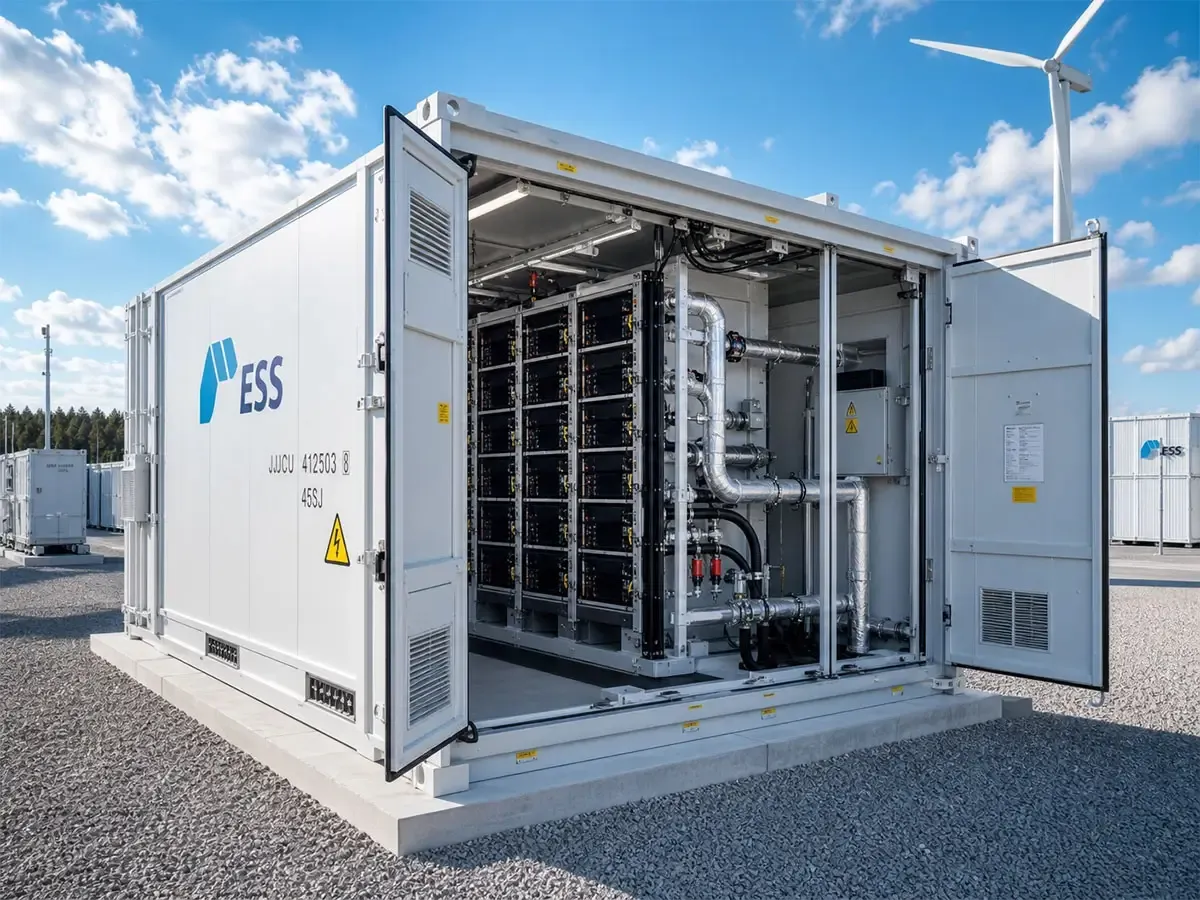
Product Overview
Leading Top Union’s liquid cooling system enclosures are engineered for high-density battery energy storage systems (BESS) where thermal management directly impacts operational lifespan and safety. Each enclosure integrates a closed-loop coolant circuit with a 50/50 ethylene-glycol water mixture, achieving a cell temperature uniformity of ±2°C across all modules. This precision eliminates hot spots that degrade lithium-ion cells, enabling continuous 1C to 2C charge and discharge rates without derating. The enclosure’s structural frame is fabricated from hot-dip galvanized steel per ASTM A123, with welded joints meeting AWS D1.1 structural welding standards. All seams are sealed to IP54 ingress protection, preventing coolant ingress and particulate contamination in environments from -40°C to +55°C ambient.
Cooling Capacity and Flow Architecture
The cooling capacity range of 50 to 200 kW per system is achieved through plate-type heat exchangers sized per ASME Section VIII, Division 1 pressure vessel code. Flow rates from 20 to 80 L/min are maintained by magnetically coupled centrifugal pumps with N+1 redundancy, ensuring continuous operation during pump maintenance or failure. Each enclosure includes dual heat exchangers—primary and backup—with automatic switching logic controlled by a PLC-based thermal management unit. Coolant temperature is regulated via a three-way modulating valve that blends return flow with chilled fluid, maintaining a supply temperature within ±1°C of setpoint. This architecture supports both LFP and NMC cell formats, with custom manifold configurations for prismatic, cylindrical, and pouch cells.
Material Selection and Corrosion Resistance
Material selection prioritizes corrosion resistance and thermal conductivity. All coolant-wetted components—piping, manifolds, and heat exchanger plates—are constructed from 316L stainless steel per ASTM A240, with EPDM seals rated for continuous exposure to glycol-water mixtures at temperatures up to 90°C. The enclosure’s external panels are powder-coated to a minimum 80-micron thickness per ISO 12944-5 C4 corrosion category, suitable for coastal and industrial environments. Internal bracing is designed to withstand seismic loads per IBC 2018 and ASCE 7-16, with vibration damping mounts isolating pumps and compressors. Each unit undergoes a 24-hour leak test at 1.5 times the maximum working pressure, validated by a calibrated mass flow meter with ±0.5% accuracy.
Thermal Performance and High-Altitude Adaptations
Thermal performance is further enhanced by the use of microchannel cold plates with a thermal resistance of 0.02°C/W per module, reducing the temperature gradient between coolant and cell surfaces. Pressure drop across the cold plate array is limited to 0.8 bar at maximum flow, ensuring pump efficiency remains above 85%. For high-altitude installations above 3,000 meters, derating factors are applied per IEC 60068-2-13, with pump motor windings insulated to Class H (180°C) to compensate for reduced air density. The coolant circuit includes a 10-micron absolute filter with a beta ratio of 1000 per ISO 16889, preventing particulate buildup that could degrade heat transfer over time. A conductivity sensor monitors coolant quality, triggering an alarm if resistivity drops below 10 MΩ·cm, indicative of ionic contamination from corrosion or mixing errors.
Applications & Industries
In oil and gas upstream operations, liquid cooling system enclosures are deployed at remote wellhead sites where ambient temperatures exceed 50°C and air-cooled systems fail to maintain battery cell temperatures below 35°C. For example, a 150 kW enclosure installed at a Permian Basin gas compression station maintained cell temperature uniformity within ±1.8°C across 48 NMC modules during a 12-month field trial, reducing capacity fade by 28% compared to forced-air cooling. The enclosure’s redundant pump configuration and -40°C cold-start capability ensure reliable operation during winterization cycles, meeting API 6A and API 17D requirements for hazardous area installations. Coolant freeze protection is validated per ASTM D1177, with a pour point below -45°C for the 50/50 glycol-water mixture.
Offshore Wind and Marine Environment Performance
Offshore wind energy platforms require enclosures that withstand salt spray, vibration, and limited maintenance access. Leading Top Union’s design incorporates DNV-GL Type Approval certification for marine environments, with all fasteners in A4-80 stainless steel per ISO 3506 and electrical enclosures rated IP66. A 200 kW system installed on a 12 MW offshore wind turbine in the North Sea demonstrated 99.97% uptime over 18 months, with coolant flow maintained at 75 L/min through dual 5-micron filters. The enclosure’s heat exchangers are titanium-plated per ASTM B265 Grade 2 to resist chloride-induced pitting, and the control system interfaces with the turbine SCADA via Modbus TCP/IP. Thermal performance data logged at 1-second intervals showed cell temperature variation of only ±1.5°C during a 2C charge event in 8-meter wave conditions.
Mining and Hazardous Environment Certification
Mining operations benefit from the enclosure’s ability to handle high dust loads and shock loads up to 5g. A 100 kW system deployed at a copper mine in Chile’s Atacama Desert maintained 1C continuous discharge rates for 14-hour shifts, with coolant temperature rise limited to 4°C above ambient despite 45°C daytime peaks. The enclosure’s IP54-rated filter system uses washable stainless steel mesh per ISO 16890, and the PLC automatically increases pump speed by 15% when differential pressure across the heat exchanger exceeds 0.3 bar. In underground coal mines, the enclosure is certified to ATEX Directive 2014/34/EU for Group I, Category M2 equipment, with all electrical components in explosion-proof housings. Coolant is switched to a food-grade propylene-glycol mixture per NSF 61 for potable water compliance when used in longwall shearer battery backup systems.
Data Center Direct-to-Chip Cooling Integration
For data center applications, the enclosure supports direct-to-chip cooling of high-power racks, with a cooling capacity of 150 kW per 42U cabinet. Coolant temperature is maintained at 18°C ± 1°C to prevent condensation, with dew point monitoring per ASHRAE TC 9.9 guidelines. The enclosure’s PLC integrates with DCIM systems via SNMP or BACnet, providing real-time thermal maps and predictive maintenance alerts based on pump vibration analysis. A 200 kW system deployed at a colocation facility in Northern Virginia achieved a PUE of 1.08, reducing annual cooling costs by $45,000 compared to traditional CRAC units. The redundant pump configuration ensures N+1 compliance for Tier III data centers, with automatic failover in less than 2 seconds.
Why Choose Leading Top Union for Liquid Cooling System Enclosure
Leading Top Union holds ISO 3834-2 certification for fusion welding of metallic materials, ensuring all coolant pipe welds meet the rigorous quality requirements of EN 1090-2 EXC3 execution class. This certification mandates documented weld procedures, welder qualifications per ISO 9606-1, and non-destructive testing—including 100% radiographic inspection of pressure-containing welds per ASME Section V. For structural components, AWS D1.1 certification covers both shop and field welding, with Charpy V-notch impact testing at -20°C per ASTM E23. These certifications are verified by TÜV Rheinland and Lloyd’s Register, providing EPC firms with the documentation required for international project compliance. Every enclosure ships with a complete material traceability report per EN 10204 Type 3.1.
Manufacturing Capacity and Quality Assurance
The manufacturing facility in Suzhou operates a 15,000-square-meter production line dedicated to thermal management systems, with a monthly capacity of 120 enclosures in the 50-200 kW range. Each unit undergoes a 72-hour burn-in test under full load, simulating worst-case ambient conditions in a climate chamber calibrated to ±0.5°C per ISO 17025. Coolant flow is verified using ultrasonic flow meters with ±0.2% accuracy, and temperature sensors are calibrated against a NIST-traceable reference. A 5-year warranty is provided on all welded joints and heat exchangers, backed by a spare parts inventory that guarantees 48-hour delivery to any major port. The engineering team offers customized manifold layouts for non-standard cell geometries, with lead times of 8-12 weeks from design approval.
Compliance and Integration Support
For EPC firms requiring compliance with specific grid codes or regional standards, pre-certification testing is offered to IEEE 1547-2018 for interconnection and UL 9540A for thermal runaway propagation. These enclosures are designed to integrate with third-party BMS systems via CAN bus or RS-485, with a library of pre-configured communication profiles for major battery OEMs. Thermal simulation reports using ANSYS Fluent are also provided, validated against physical test data with a correlation coefficient of 0.97. This allows procurement engineers to verify that the enclosure will maintain ±2°C uniformity under their specific charge/discharge profiles before committing to production. Contact our technical sales team for a project-specific thermal analysis and a detailed compliance matrix for your next BESS project.