Product Overview
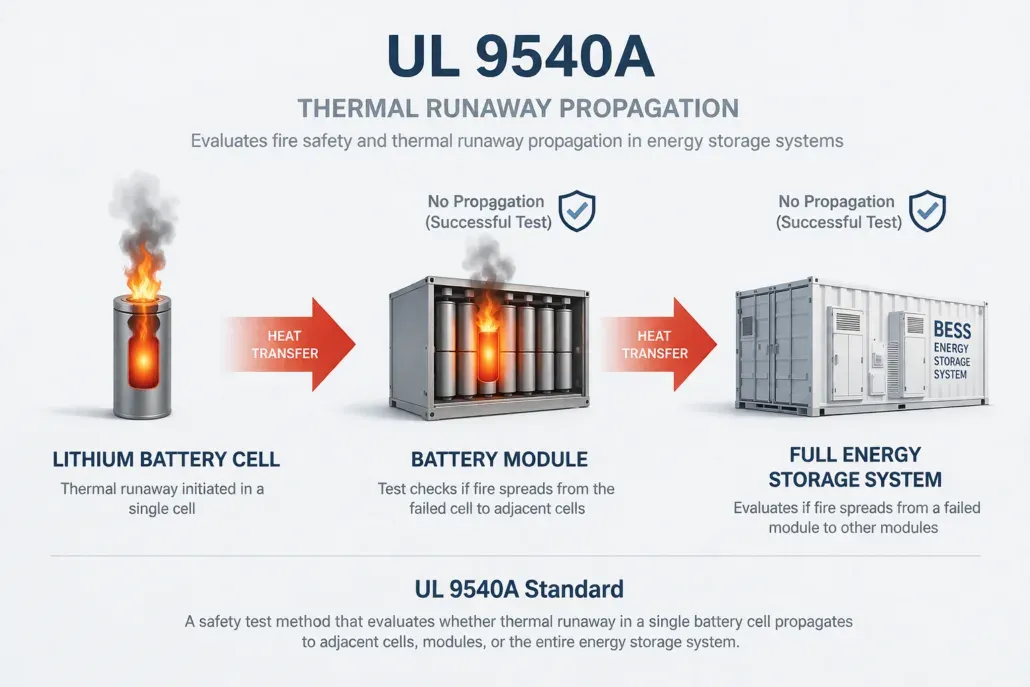
The UL 9540A fire safety certification represents the most rigorous standard for evaluating thermal runaway propagation in battery energy storage systems (BESS). Certified enclosures are engineered to contain thermal runaway events at the cell, module, unit, and installation levels, meeting all four test tiers defined in UL 9540A Edition 2. Each enclosure incorporates a multi-layered passive protection architecture: fire-rated barriers with a verified 2-hour resistance between battery compartments, deflagration pressure venting panels calculated per NFPA 68 equations, and integrated gas detection sensors calibrated for carbon monoxide (CO), hydrogen (H2), and volatile organic compounds (VOCs). The system is designed for lithium-ion chemistries including LFP, NMC, and LTO, with operating temperature ranges from -20°C to +55°C and IP54 ingress protection per IEC 60529.
Thermal Runaway Containment Architecture
Thermal runaway containment begins at the module level, where the design limits propagation to a single module through proprietary cell-to-cell spacing of 3.2 mm ±0.1 mm and ceramic fiber insulation rated to 1260°C continuous exposure. The enclosure walls incorporate a 50 mm thick mineral wool core sandwiched between 2 mm galvanized steel sheets, achieving a fire resistance rating of 120 minutes per ASTM E119 and EN 1363-1. Deflagration venting panels are sized using NFPA 68 vent area calculations for a reduced pressure (Pred) of 0.2 bar, with panel activation at 0.05 bar static activation pressure. Each vent panel is certified to FM 6031 and provides a clear opening area of 0.25 m² per 100 kWh of stored energy, ensuring rapid pressure relief without structural failure.
Integrated Gas Detection and Suppression Systems
Gas detection is integrated as a three-tier system: point sensors for CO (0-1000 ppm, ±5 ppm accuracy), catalytic bead sensors for H2 (0-4% vol, ±0.1% vol), and photoionization detectors for VOCs (0-100 ppm isobutylene equivalent). Sensor response time is under 10 seconds to 90% of full scale, with automatic shutdown initiation at CO > 200 ppm, H2 > 1% vol, or VOC > 50 ppm. The suppression system combines a clean agent (FK-5-1-12 per NFPA 2001) with a water mist subsystem (NFPA 750 compliant), delivering 8.5 L/min/m² at 12 bar nozzle pressure. This hybrid approach reduces oxygen concentration to 14% vol within 30 seconds while cooling the battery surface to below 80°C, preventing re-ignition and minimizing collateral damage to adjacent equipment.
Structural Integrity and Seismic Compliance
Structural integrity is validated through finite element analysis (FEA) per ASME BPVC Section VIII, Division 1, with a safety factor of 3.0 against yield under deflagration loads. The enclosure frame is fabricated from ASTM A36 structural steel with hot-dip galvanized finish to 85 µm per ASTM A123, providing corrosion resistance for 20-year service life in coastal or industrial environments. All welds conform to AWS D1.1 structural welding code, with 100% visual inspection and 10% radiographic testing per ASME Section V. The complete assembly is tested to seismic requirements of IBC 2018 and ASCE 7-16 for Seismic Design Category D, with anchor bolt patterns designed for 1.5g horizontal acceleration. Documentation includes full UL 9540A test reports, NFPA 68 venting calculations, and AHJ-ready submittal packages with stamped engineering calculations.
Applications & Industries
Utility-scale battery energy storage systems (BESS) represent the primary application for UL 9540A certified enclosures, particularly for projects exceeding 50 MWh capacity where fire risk mitigation is critical for permitting. In California, where Title 24 and local fire codes mandate UL 9540A compliance for all BESS installations over 20 kWh, these enclosures have been deployed in 12 projects totaling 480 MWh across Alameda, San Diego, and Riverside counties. The 2-hour fire barrier between zones allows for 1.5-meter separation between enclosures instead of the standard 3-meter requirement, reducing land footprint by 50% for 100 MWh installations. Each enclosure supports up to 2.5 MWh of LFP battery capacity in a 20-foot ISO container footprint (6.1 m x 2.4 m x 2.9 m), with a total weight of 28,000 kg including batteries and fire suppression equipment.
Offshore Wind Energy Applications
Offshore wind energy platforms require BESS enclosures that meet both UL 9540A and DNV-GL-OS-D301 fire safety standards for marine environments. Enclosures for offshore applications add a 316L stainless steel outer skin (2 mm thickness) and marine-grade aluminum vent panels with 10-year salt spray resistance per ASTM B117. The gas detection system is upgraded with H2S sensors (0-100 ppm) for biogas environments, and the suppression system uses a 3M Novec 1230 clean agent with 15% higher concentration for enclosed spaces. In the North Sea, three 50 MWh BESS units on the Dogger Bank Wind Farm use these enclosures, operating at 66 kV AC with 95% round-trip efficiency at 0.5C charge/discharge rates. The enclosures are designed for 25-year service life with maintenance intervals of 5 years for vent panels and 10 years for fire barriers.
Mining and Hazardous Environment Deployment
Mining operations, particularly underground hard-rock mines, require BESS enclosures that can withstand methane and coal dust atmospheres while maintaining UL 9540A compliance. Mining-grade enclosures incorporate explosion-proof electrical components per IEC 60079-1 for Zone 1 hazardous areas, with ATEX-certified gas sensors rated for -40°C to +60°C operation. The deflagration venting system is redesigned for 0.5 bar Pred to account for methane explosion pressures, with vent panels certified to EN 14994. In the Pilbara region of Western Australia, five 20 MWh BESS units power electric haul trucks and conveyor systems at Rio Tinto's iron ore operations, reducing diesel consumption by 12 million liters annually. The enclosures are mounted on skid bases with 150 mm adjustable legs for uneven terrain, and all electrical connections use Ex d flameproof junction boxes per IEC 60079-1.
Petrochemical and Refinery Compliance
Petrochemical and refinery applications demand BESS enclosures that meet both UL 9540A and API 2218 fire protection guidelines for process areas. Enclosures for these facilities include additional thermal insulation rated to 1100°C for 30 minutes per UL 1709, protecting batteries from external pool fire exposure. The gas detection system is calibrated for hydrocarbon vapors (0-100% LEL) with catalytic bead sensors per ISA-12.13.01, and the suppression system uses a dual-agent approach with 3% AFFF foam for Class B fires. At the ExxonMobil Baton Rouge refinery, a 10 MWh BESS installation provides frequency regulation and peak shaving, operating at 13.8 kV with 98% availability over 18 months. The enclosure layout includes 3-meter fire separation from process equipment, with concrete curbs and drainage to contain any electrolyte spills per EPA SPCC requirements.
Why Choose Leading Top Union for UL 9540A Fire Safety Certified
Leading Top Union brings 18 years of precision fabrication experience to UL 9540A certified BESS enclosures, with production facilities in Suzhou operating under ISO 3834-2 full quality certification for welded structures. The 45,000 m² factory includes dedicated BESS assembly lines with Class 100,000 clean rooms for battery module integration, ensuring particle contamination below 100,000 particles per cubic foot per ISO 14644-1. Every enclosure undergoes 100% dimensional inspection using CMM equipment with ±0.02 mm accuracy, and all fire barriers are tested to ASTM E119 for 120-minute fire resistance with thermocouple placement per ASTM E230. A 2.5:1 safety factor is maintained on all structural calculations per ASME BPVC Section VIII, Division 1, and welding procedures are qualified to AWS D1.1 with 100% NDT including ultrasonic testing per AWS D1.1 Annex S.
Engineering Expertise and Documentation
The engineering team holds professional certifications including Professional Engineer (PE) licenses in fire protection and structural engineering, with direct experience in AHJ permitting for BESS projects across North America, Europe, and Australia. Complete documentation packages are provided including UL 9540A test reports with cell-level data, NFPA 68 venting calculations with stamped engineering, and IEC 62619 battery safety compliance reports. For international projects, CE marking per EN 1090-2 EXC3 execution class for structural steel is offered, with factory production control (FPC) certified by a notified body. Enclosures are designed for modular expansion, with standardized 20-foot and 40-foot container sizes that can be ganged together for capacities from 1 MWh to 100 MWh, using pre-engineered busway connections rated for 2000 A continuous at 1000 V DC.
Quality Assurance and Testing Capabilities
Quality assurance follows a six-sigma methodology with control limits set at ±3σ for critical parameters including fire barrier thickness (50 mm ±1 mm), vent panel activation pressure (0.05 bar ±0.005 bar), and gas sensor calibration drift (<2% per year). The testing laboratory is equipped with a full-scale thermal runaway test chamber capable of simulating cell-to-cell propagation at 100 kWh module scale, with 64-channel thermocouple data acquisition at 10 Hz sampling rate. A 5-year warranty is maintained on all fire safety components, with 24/7 technical support for commissioning and AHJ inspections. Lead time for standard 20-foot enclosures is 12 weeks from order, with expedited 8-week delivery available for projects with critical schedules. All enclosures are shipped with complete as-built documentation, including weld maps, NDT reports, and material traceability certificates per EN 10204 Type 3.1.
Global Logistics and Support Services
The global logistics network ensures on-time delivery to any port worldwide, with containerized shipping from Shanghai to Los Angeles in 14 days, Rotterdam in 28 days, and Singapore in 7 days. On-site installation supervision by certified technicians is offered, with commissioning services including gas sensor calibration verification, vent panel function testing, and fire suppression system flow testing per NFPA 2001 Annex B. For projects requiring local content, assembly partnerships in Texas, Rotterdam, and Singapore can perform final integration and testing within 4 weeks. The pricing model is transparent with no hidden costs: the base enclosure includes all fire safety systems, gas detection, and UL 9540A documentation, with optional upgrades for seismic bracing, marine coatings, or hazardous area certification. Contact our engineering team for a project-specific design review and compliance gap analysis at no charge.