Product Overview
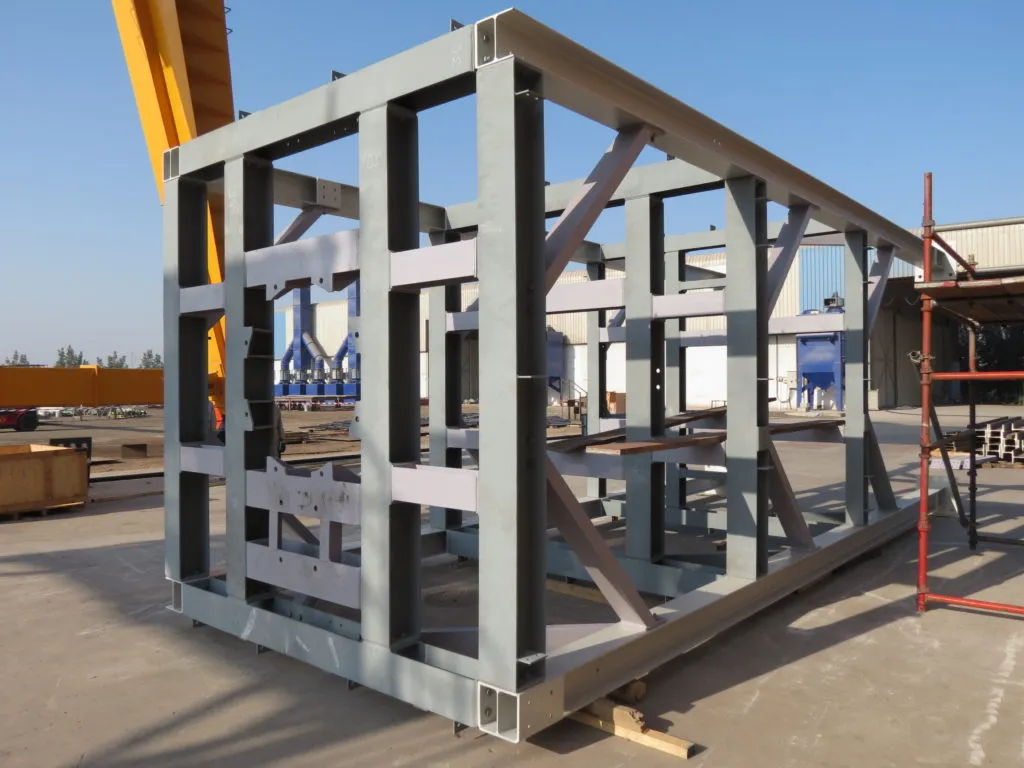
Mining equipment frames fabricated by Leading Top Union are engineered to withstand the extreme cyclic loading, impact forces, and abrasive environments encountered in surface and underground mining operations. High-strength steel grades including S355J2+N, S460ML, S690QL, and Hardox 400/500 are used, selected based on yield strength requirements ranging from 355 MPa to 690 MPa. Plate thicknesses from 10 mm to 200 mm are welded using flux-cored arc welding (FCAW), submerged arc welding (SAW), and gas metal arc welding (GMAW) processes, all qualified under AWS D1.1:2020 structural welding code. Every critical weld undergoes 100% ultrasonic testing (UT) per ASTM E164, supplemented by magnetic particle testing (MT) and dye penetrant testing (PT) on surface-breaking discontinuities. For assemblies requiring dimensional stability under dynamic loads, stress-relief heat treatment is applied in accordance with ASME BPV Code Section VIII, holding temperatures at 595°C ± 15°C for one hour per 25 mm of thickness, followed by controlled cooling to minimize residual stress.
Precision Machining and Dimensional Control
The fabrication process integrates precision machining of mounting surfaces and bearing housings to achieve tolerances of ±0.05 mm on critical bores and ±0.1 mm on flatness across 1-meter spans. This is accomplished using 5-axis CNC boring mills and gantry-type milling machines with positioning accuracy of ±0.02 mm per meter. For mining equipment frames supporting draglines, excavators, and haul trucks, interface surfaces are machined to meet OEM specifications for bolt hole patterns, dowel pin locations, and surface finish requirements of Ra 3.2 μm or better. Single-piece weight capacity reaches 60 tons, enabling fabrication of complete undercarriage frames, boom sections, and chassis assemblies without intermediate splices. Each frame is verified against dimensional reports using laser trackers with volumetric accuracy of ±0.03 mm, ensuring interchangeability with existing equipment on site.
Material Traceability and Welding Quality Assurance
Material traceability is maintained from mill certificate to final assembly, with each steel plate identified by heat number and grade per EN 10204 Type 3.1 certification. For Hardox 400 and 500 grades, SSAB’s recommended welding parameters are followed, including preheat temperatures of 100°C to 200°C depending on thickness, and interpass temperature limits of 250°C to avoid hydrogen-induced cracking. Welding consumables are selected to match base metal strength: ER70S-6 for S355, ER100S-G for S460, and ER120S-G for S690, all with diffusible hydrogen content below 5 mL/100 g per AWS A4.3. Post-weld heat treatment is mandatory for S690QL frames exceeding 50 mm thickness to achieve hardness values below 350 HV10 and ensure fracture toughness at temperatures down to -40°C, critical for mining operations in Arctic regions. The quality management system is certified to ISO 3834-2 for full welding quality, EN 1090-2 EXC3 for execution class, and AWS D1.1 for structural steel.
Applications & Industries
Mining equipment frames fabricated at Leading Top Union serve as structural backbones for heavy machinery operating in open-pit and underground mines worldwide. In surface mining, frames are used in electric rope shovels with bucket capacities up to 120 cubic meters, where the main deck frame must support dynamic loads exceeding 2,000 metric tons during digging cycles. These frames are typically fabricated from S690QL steel with plate thicknesses of 100 mm to 200 mm in boom foot areas, welded with full-penetration joints and inspected by phased array ultrasonic testing (PAUT) per ASTM E2491. For dragline operations, walking mechanism frames and tub structures are produced that distribute 5,000-ton static loads across ground-bearing surfaces, requiring flatness tolerances of ±1 mm over 10-meter diameters to prevent binding during rotation. Stress-relief heat treatment is applied to all dragline tub frames to eliminate welding-induced distortion and ensure service life exceeding 20 years under continuous operation.
Underground Mining Frame Specifications
Underground mining applications demand compact, high-strength frames for load-haul-dump (LHD) vehicles, roof bolters, and continuous miners. Frames for LHD units with payload capacities of 10 to 25 tons are fabricated from Hardox 400 with thicknesses of 20 mm to 60 mm, providing abrasion resistance against rock impact while maintaining weldability for complex geometries. Articulation joints and pivot points are machined to tolerances of ±0.05 mm and fitted with bronze bushings or spherical bearings rated for 500,000 cycles at full load. For roof bolter frames, integral hydraulic tank mounts and drill guide rails are machined to ±0.1 mm alignment, ensuring bolt pattern accuracy within 2 mm over 6-meter lengths. These frames undergo 100% MT inspection on all fillet welds per ASTM E709 and are pressure-tested for hydraulic circuits at 1.5 times working pressure to 350 bar. Experience includes frames for Sandvik, Atlas Copco, and Caterpillar underground equipment, with designs validated by finite element analysis (FEA) per ASME VIII Div. 2 elastic stress limits.
Mineral Processing and Material Handling Applications
Beyond conventional mining, frames support specialized equipment in mineral processing and material handling. For semi-mobile crushing plants with throughput capacities of 5,000 to 12,000 metric tons per hour, support frames are fabricated from S460ML steel with thicknesses up to 150 mm, designed to absorb impact loads from gyratory crushers and vibrating feeders. These frames incorporate machined mounting pads for crusher bases with flatness of ±0.2 mm over 3-meter spans, ensuring proper alignment of eccentric shafts and bearings. For overland conveyor systems spanning distances up to 20 kilometers, head and tail pulley frames are produced with shaft bores machined to H7 tolerances and bearing housing fits per ISO 286. Each frame is designed for bolted field assembly with high-strength friction-grip bolts per EN 1090-2, preloaded to 70% of proof load using calibrated torque wrenches. Frames are also used in mine dewatering pump stations, where S355J2 steel structures support vertical turbine pumps with motor ratings up to 3,000 kW, requiring vibration limits below 4.5 mm/s RMS per ISO 10816-3.
Why Choose Leading Top Union for Mining Equipment Frames
ISO 3834-2 certification ensures that every mining equipment frame is fabricated under a comprehensive welding quality system covering procedure qualification, welder certification, and inspection protocols. Welding procedures are qualified to AWS D1.1 for structural steel and ASME Section IX for pressure-containing components, with supporting PQRs for all steel grades from S355 to Hardox 500. For critical frames used in Komatsu PC8000 and Liebherr R 9800 excavators, pre-qualified joint designs are maintained with groove angles of 30° to 45°, root openings of 3 mm to 6 mm, and backing bars as required to achieve full penetration. Each welder is certified to AWS D1.1 Table 4.2 for unlimited thickness and position, with annual recertification including bend tests and radiographic examination. NDT technicians hold ASNT Level II and III certifications in UT, MT, and PT, with 100% UT performed on all complete-joint-penetration (CJP) welds using 2.25 MHz transducers calibrated on ASTM E164 reference blocks.
Manufacturing Capacity and Machining Capabilities
The manufacturing facility in Suzhou operates three shifts with capacity to produce over 200 metric tons of fabricated frames per week, supported by 15 overhead cranes with capacities from 10 to 100 tons. For frames exceeding 60 tons, multi-crane lifts are coordinated using synchronized hoists with load cells accurate to ±2% of rated capacity. Machining capabilities include a 6-meter by 3-meter CNC boring mill with 160 mm spindle diameter, achieving positioning accuracy of ±0.01 mm and repeatability of ±0.005 mm. Surface grinding of mounting faces is performed on a 2-meter by 1-meter magnetic chuck grinder, holding flatness to 0.02 mm per meter. All machined surfaces are protected with rust-preventive oil conforming to MIL-PRF-16173 Grade 2, and critical bores are fitted with plastic caps for shipment. Full dimensional inspection reports are provided with CMM data for up to 200 measurement points per frame, traceable to NIST standards.
Industry Collaboration and Performance Track Record
Direct collaboration with Caterpillar, Komatsu, and Liebherr on frame specifications for mining equipment operating in Chile, Australia, and Indonesia has been established. Over 500 frames have been fabricated for electric rope shovel carbodies, each weighing 45 to 55 tons, with weld joint efficiencies exceeding 95% per AWS D1.1. For these projects, robotic welding was implemented for longitudinal seams using FCAW with 1.6 mm diameter wire, achieving deposition rates of 8 kg per hour and travel speeds of 400 mm per minute. Stress-relief heat treatment is performed in a gas-fired furnace measuring 8 meters by 4 meters by 3 meters, with temperature uniformity of ±10°C across the chamber and programmable ramp rates of 50°C per hour. Quality records show a first-pass yield rate of 98.5% on mining frames, with rework limited to minor cosmetic defects. A 24-month warranty against weld failure and dimensional deviation is offered, backed by liability insurance covering up to USD 10 million per occurrence. Contact the engineering team at sales@leadingtopunion.com for frame design review and quotation within 48 hours.