Product Overview
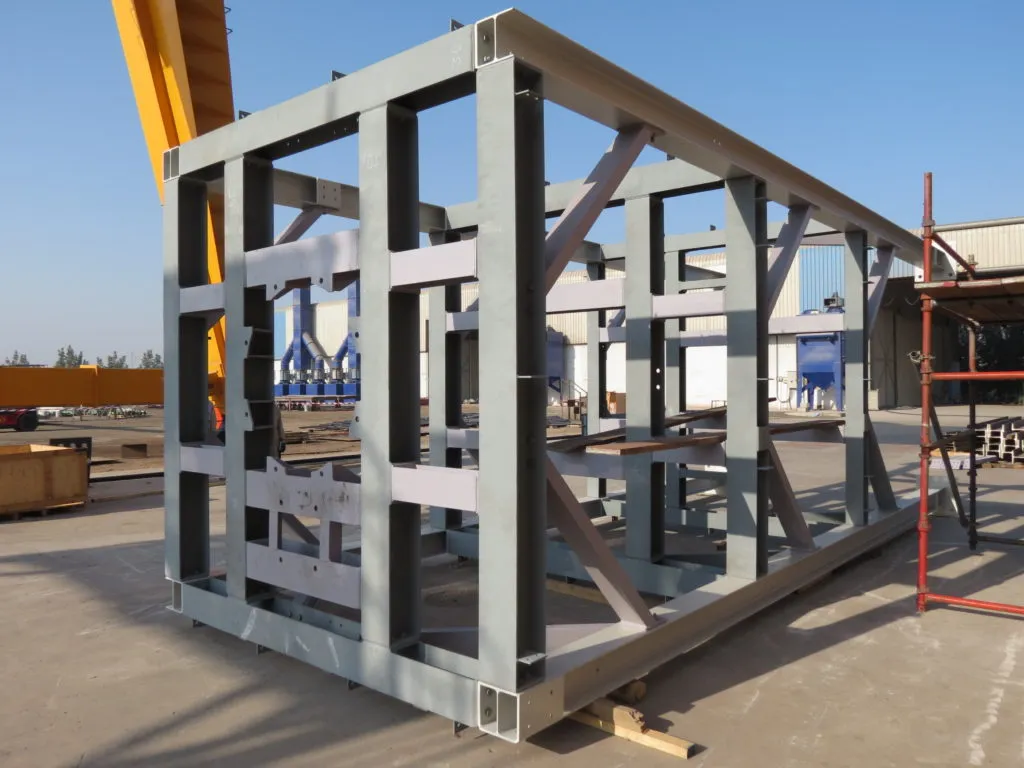
Steel bridge structures demand precision engineering to withstand dynamic loads, thermal cycles, and fatigue over a 100-year design life. Plate girders, orthotropic decks, and bearing assemblies are fabricated for highway, railway, and pedestrian bridges at a facility in Suzhou supporting single-piece girder lengths up to 30 meters and depths to 4,000 mm, with plate thicknesses from 12 mm to 100 mm. Structural steel grades S355J2/K2 per EN 10025, A709-50W per ASTM, and Q345qD per GB/T 714 are used exclusively, ensuring compliance with international bridge specifications. Every weld is executed under AWS D1.5 Bridge Welding Code, with fracture-critical member (FCM) procedures for tension components where failure would cause collapse. ISO 3834-2 certification guarantees full traceability from mill certificates to weld maps, and NDT is performed on 100% of groove welds in main load-carrying members.
Orthotropic deck panels represent a specialized capability within this steel bridge structures portfolio. These panels combine a thin steel deck plate (typically 12–16 mm) with closed-section longitudinal ribs and transverse crossbeams to create a lightweight, high-strength system that distributes wheel loads directly to main girders. Fabrication uses automated submerged arc welding (SAW) for longitudinal rib-to-deck joints and flux-cored arc welding (FCAW) for field splices, with rib spacing optimized for fatigue resistance. Welding procedures are qualified per AWS D1.5 Annex A for fatigue-prone details, with profile control to maintain rib weld penetration above 80% of the deck thickness. Cope holes and drain details are incorporated per AASHTO LRFD specifications to prevent water accumulation and corrosion initiation at critical weld toes. For orthotropic decks subjected to heavy truck traffic, fatigue tests have demonstrated a service life exceeding 2 million cycles at stress ranges of 70 MPa, with rib-to-deck welds showing no crack initiation when weld toe radii are maintained at 2 mm or greater. Additionally, closed-rib cross-section tolerances are held to ±0.5 mm to ensure uniform load distribution across adjacent ribs, a critical factor in preventing localized stress concentrations that can reduce fatigue life by up to 40%.
Bearing plates and expansion joint components are integral to steel bridge performance, accommodating thermal movement, rotation, and live load deflection. Fixed and guided bearings are fabricated from S355J2+N plate with stainless steel sliding surfaces (ASTM A240 Type 304) and PTFE-based low-friction pads achieving a coefficient of friction below 0.05 per EN 1337-2. Expansion joint assemblies are machined from A709-50W steel with elastomeric seals rated for movement ranges from ±50 mm to ±300 mm, tested for watertightness at 0.1 MPa hydrostatic pressure. The shop coating system follows SSPC-SP10 near-white blast cleaning to achieve a 75–100 µm anchor profile, followed by a zinc-rich primer (minimum 85% zinc in dry film) at 75–125 µm DFT, intermediate epoxy at 125–200 µm, and polyurethane topcoat at 50–75 µm. This system provides corrosion protection for C5-M (marine) and CX (extreme) environments per ISO 12944, with a 15-year maintenance-free service life in coastal bridge applications. For curved bridges with superelevation, bearing assemblies are designed to accommodate rotations of up to 0.05 radians under full live load, with elastomeric pads tested for compressive creep below 5% after 1,000 hours at 70°C per ASTM D395.
Applications & Industries
Highway and railway bridges form the primary application for these steel bridge structures, with projects ranging from single-span crossings to multi-span continuous girders. For a recent highway bridge in Southeast Asia, 12 plate girders each 28.5 meters long, 2,800 mm deep, with 50 mm thick flanges in A709-50W steel were supplied. The design required fatigue category B details per AASHTO for all welded connections, with ultrasonic testing (UT) on 100% of full-penetration flange-to-web welds. Cross-frames and lateral bracing were fabricated using L152x152x12.7 angles, bolted with ASTM A325 high-strength bolts in slip-critical connections. The project timeline demanded just-in-time delivery to a congested urban site, which was met by staging girder shipments in three batches over eight weeks, each piece match-marked per the erection sequence. For railway bridges, dynamic load factors of 1.67 per AREMA Chapter 15 are applied to account for impact from passing trains, with fatigue design based on 2 million cycles at stress ranges up to 110 MPa for main members.
Offshore wind farm access bridges and transition piece platforms represent a growing application for this steel bridge fabrication expertise. These structures must withstand salt spray, wave loading, and temperatures from -20°C to +50°C while maintaining structural integrity for 25-year service life. Box girders and truss bridges for turbine access are fabricated using S355J2+N steel with Charpy V-notch impact testing at -40°C per EN 10025-2. Welding follows EN 1090-2 EXC3 execution class, with preheat control based on carbon equivalent values (CEV ≤ 0.45%) to prevent hydrogen-induced cracking. For a North Sea wind farm project, 18 access bridges each 22 meters long, 1.5 meters wide, with hot-dip galvanized coating per EN ISO 1461 (minimum 85 µm per face) and additional epoxy topcoat for UV resistance were delivered. Each bridge was proof-loaded to 1.25 times the design live load (5 kN/m²) before shipment. Fatigue-critical details in offshore bridges are designed for stress ranges of 50 MPa or less at 10 million cycles, with weld toes ground flush to a 0.5 mm radius to reduce stress concentration factors by up to 30%.
Mining and material handling industries require steel bridge structures for conveyor galleries, transfer towers, and haul road crossings where heavy equipment loads and abrasive environments are common. Truss bridges and gantry structures are fabricated from Q345qD steel (yield strength 345 MPa minimum) with bolted field connections for rapid assembly in remote locations. For a copper mine in Chile, a 40-meter span conveyor bridge with a 1,200 mm wide belt carrying 3,500 tonnes per hour of crushed ore was supplied. The structure was designed for seismic Zone 3 per ASCE 7-16, with base shear coefficients of 0.25g and ductility demands met through moment-resisting connections. All steel was blasted to SSPC-SP6 commercial grade and coated with a three-layer epoxy system (zinc-rich primer, micaceous iron oxide intermediate, polyurethane topcoat) for abrasion resistance in dust-laden conditions. The bridge was delivered in five pre-assembled modules, each under 20 tonnes for helicopter lift installation. In mining applications, live loads can exceed 15 kN/m² for conveyor systems, with impact factors of 1.3 applied to account for ore drop loads, and deflection limits are set at L/400 to prevent belt misalignment.
Why Choose Leading Top Union for Steel Bridge Structures
The fabrication facility in Suzhou is equipped with CNC plasma cutting tables (6m x 20m bed capacity), automated submerged arc welding gantries, and hydraulic plate bending rolls capable of forming 100 mm thick plate to radii as tight as 1,500 mm. This equipment enables production of curved girders for horizontally aligned bridges and skewed end connections for non-orthogonal abutments. Dimensional tolerances of ±2 mm on girder depth and ±1 mm on flange width per AWS D1.5 Table 7.1 are maintained, with camber profiles verified by total station survey before shipment. The quality management system is certified to ISO 3832-2, ISO 9001:2015, and EN 1090-1, with factory production control (FPC) audited annually by a notified body. DNV-GL type approval is also held for welding procedures used in offshore bridge applications, covering material thicknesses from 8 mm to 120 mm. For complex geometries, 3D laser scanning is used to verify girder camber within ±1 mm of specified profiles, with deviations corrected through controlled heating or mechanical straightening before final inspection.
Procurement engineers at global EPC firms benefit from an integrated project management approach, which includes 3D modeling in Tekla Structures for clash detection and erection sequencing, plus weekly progress reports with photographic documentation. Full material traceability is provided from mill test reports (MTRs) to weld consumable batch numbers, with NDT reports (UT, MT, RT, PT) archived for 10 years per project requirements. The logistics team coordinates sea freight from Shanghai port to job sites worldwide, with girder shipments secured on flat-rack containers or break-bulk vessels using engineered cradles and tie-downs. For a recent bridge project in Australia, 24 girders were delivered in six shipments over 12 weeks, each piece protected with vapor-phase corrosion inhibitor (VCI) packaging and polyethylene shrink wrap for the 45-day sea voyage. On-site welding support for field splices is also offered, with AWS-certified welding inspectors (CWI) available for quality verification at your project location. For projects requiring accelerated schedules, parallel fabrication lines can be mobilized to reduce lead times by up to 30%, with production capacity exceeding 5,000 tonnes of steel bridge components per year.