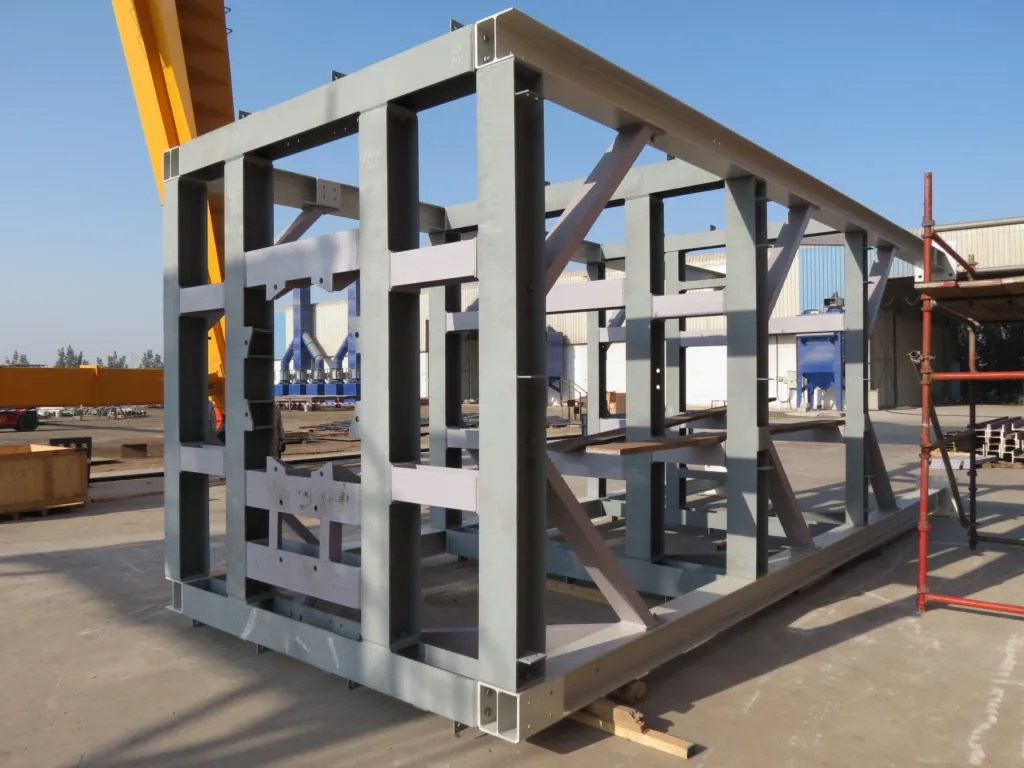
Product Overview
EN 1090 certified fabrication from Leading Top Union (领拓互联) delivers structural steel components that meet the rigorous demands of European construction and industrial applications. The Suzhou facility operates under an annually audited Factory Production Control (FPC) system, ensuring consistent quality across all execution classes—EXC2, EXC3, and EXC4. This certification, mandated under Construction Products Regulation (CPR) 305/2011, enables CE marking for steel structures used in load-bearing applications across the European Economic Area. Components are fabricated from structural grades including S235, S275, S355, and S460, with plate thicknesses ranging from 6 mm to 120 mm and beam sections up to 1000 mm in depth.
Execution Class Compliance and Welding Standards
The EN 1090-2 standard governs technical requirements for steel structures, and compliance spans all three execution classes. For EXC2, standard building frames and bridge components are handled with weld throat thicknesses from 4 mm to 12 mm. EXC3 fabrication applies to structures with moderate fatigue loading, such as crane runways and offshore topsides, where tighter tolerances are maintained on weld preparation angles (±2°) and root gaps (±1 mm). EXC4 covers high-risk applications like pressure vessels and seismic-resistant frames, requiring full volumetric NDT and Charpy V-notch impact testing at -20°C for base metals and weld metals alike. The welding coordination team, certified per EN ISO 14731, oversees all procedures and ensures compliance with EN ISO 15614-1 for procedure qualification.
Material Traceability and Inspection Protocols
Material traceability forms the backbone of the EN 1090 certified fabrication process. Every steel plate, section, and fitting arrives with EN 10204 Type 3.1 or 3.2 inspection certificates, verified against mill test reports. Unique heat numbers and batch codes are assigned to each incoming lot, tracking them through cutting, beveling, welding, and final assembly via the ERP system. For critical applications, positive material identification (PMI) is performed using optical emission spectrometry on 100% of high-strength steels and 10% of standard grades. This traceability chain extends to consumables—welding wires, fluxes, and shielding gases—all documented per EN ISO 14341 and EN ISO 14175. The result is a fully auditable production record that satisfies third-party inspectors from TÜV, SGS, or DNV-GL.
Non-Destructive Testing and Weld Integrity
Non-destructive testing (NDT) per EN ISO 17635 ensures weld integrity across all execution classes. For EXC3 and EXC4 projects, phased array ultrasonic testing (PAUT) is applied on 100% of full-penetration butt welds in plates over 20 mm thick, detecting planar defects as small as 1 mm in height. Magnetic particle inspection (MPI) per EN ISO 17638 covers all fillet welds and surface-breaking cracks, while radiographic testing (RT) per EN ISO 17636-1 validates internal soundness on critical joints. NDT technicians hold Level II certifications per EN ISO 9712, and all equipment is calibrated to ISO 17025 standards. Acceptance criteria follow EN ISO 5817 for weld imperfections, with limits set to quality level B for EXC4 and level C for EXC3. This rigorous inspection regime reduces field rework rates to below 0.5% by weight of fabricated steel.
Welder Qualification and Performance
Welder qualifications per EN ISO 9606-1 guarantee skilled labor for every joint. Welders are certified for process 135 (MAG solid wire), 136 (MAG flux-cored), 111 (manual metal arc), and 141 (TIG) across all positional categories—PA, PC, PF, and PE. Each qualification test includes bend tests, macro-etch examinations, and radiographic inspection per EN ISO 9606-1 Annex A. A rolling certification schedule is maintained, requalifying welders every two years or after any six-month break in production. For EXC4 work, welders must demonstrate proficiency on material thicknesses up to 80 mm and on high-strength grades like S460N and S690QL. This approach ensures that the fabrication team delivers consistent weld quality, with defect rates averaging below 0.3% based on internal audits over the past three years.
Applications & Industries
EN 1090 certified fabrication from Leading Top Union serves the oil and gas sector, where structural components must withstand extreme pressures and corrosive environments. Pipe rack supports, flare towers, and module frames are fabricated for onshore refineries and offshore platforms, using S355J2+N and S460NL steels with Charpy impact values of 27 J at -20°C per EN 10025-3. For a recent petrochemical project in Rotterdam, 1,200 metric tons of EXC3-certified steelwork was delivered for a hydrocracker unit, including columns with 50 mm wall thickness and flanges machined to ±0.1 mm flatness. These components required 100% PAUT and MPI, with weld hardness limited to 350 HV10 to prevent hydrogen-induced cracking. CE marking under CPR 305/2011 ensures seamless integration into European EPC contracts.
Offshore Wind Energy Structures
Offshore wind energy relies on EN 1090 EXC3 and EXC4 fabrication for monopile transition pieces, jacket foundations, and tower sections. These structures are produced from S355ML and S420ML thermomechanically rolled plates per EN 10025-4, with thicknesses from 30 mm to 80 mm for transition pieces and up to 120 mm for flanges. Fatigue design life exceeds 25 years per DNV-OS-J101, requiring weld toe grinding to a radius of 2 mm and post-weld heat treatment (PWHT) at 580°C for 2 hours per EN ISO 17663. For a 1.2 GW offshore wind farm in the North Sea, 48 jacket foundation nodes were fabricated, each weighing 85 metric tons, with 100% ultrasonic testing and magnetic particle inspection on all K-joints. EN 10204 Type 3.2 material certificates provide full traceability from mill to installation.
Mining and Mineral Processing Applications
Mining and mineral processing demand EN 1090 certified structures that resist abrasion and dynamic loading. Conveyor bridges, crusher supports, and screening station frames are fabricated from wear-resistant grades like Hardox 400 and S355J2W (weathering steel) per EN 10025-5. For a copper mine in Chile, 800 metric tons of EXC2-certified steelwork was supplied for a primary crusher building, with beam spans up to 24 meters and column heights of 18 meters. Connections used preloaded bolts per EN 1090-2, tightened to 70% of yield strength with torque values verified by calibrated wrenches. The FPC system tracks each bolt batch to EN 14399-1, ensuring slip factors of 0.5 for friction-grip joints. This level of control reduces structural maintenance costs by an estimated 15% over a 20-year service life.
Power Generation and Utility Infrastructure
Power generation facilities—including combined-cycle gas turbines, coal-fired plants, and nuclear auxiliary buildings—require EN 1090 EXC3 fabrication for turbine pedestals, heat recovery steam generator (HRSG) supports, and cooling tower structures. S355J2+N steel is used with 0.20% max carbon equivalent (CEV) per EN 1011-2 to ensure weldability without preheat for thicknesses under 30 mm. For a 500 MW gas turbine plant in Germany, 600 metric tons of EXC3-certified steelwork was fabricated for the HRSG module, with 40 mm thick header plates and 8 mm thick fin tubes welded using 135 process with ER70S-6 wire. All welds underwent 100% radiographic testing per EN ISO 17636-1, with acceptance level B. CE marking documentation includes declarations of performance (DoP) per EN 1090-1, simplifying regulatory approval for European utilities.
Shipbuilding and Offshore Classification
Shipbuilding and offshore structures benefit from EN 1090 certified fabrication, which aligns with classification society rules from DNV-GL, Lloyd's Register, and Bureau Veritas. Deck houses, crane pedestals, and pipe supports are produced from shipbuilding grades like DH36 and EH36 per EN 10025-2, with Charpy V-notch testing at -20°C for 27 J minimum. For a 15,000-tonne floating production storage and offloading (FPSO) vessel, 1,500 metric tons of EXC3-certified steelwork was fabricated for the topside module, including 60 mm thick stiffened panels and 30 mm thick brackets. Welding procedures were qualified per EN ISO 15614-1 with additional CVN testing at -40°C for arctic service. The NDT program includes 100% ultrasonic testing on all butt welds and 20% on fillet welds, meeting both EN 1090-2 and DNV-GL-OS-C401 requirements.
Why Choose Leading Top Union for EN 1090 Certified Fabrication
Leading Top Union combines EN 1090 certification with ISO 3834-2 quality management for welding, creating a dual-standard framework that exceeds typical European fabricators. ISO 3834-2 certification, audited by TÜV Rheinland, requires comprehensive welding coordination per EN ISO 14731, with three levels of coordinators—Level A for EXC4 projects, Level B for EXC3, and Level C for EXC2. This structure ensures that every weld procedure specification (WPS) is reviewed by a qualified engineer, with preheat and interpass temperatures controlled to ±10°C using infrared pyrometers. For a recent EXC4 project involving 80 mm thick S460QL plates, the coordination team specified a preheat of 150°C and PWHT at 580°C for 3 hours, achieving hardness values below 320 HV10 across all heat-affected zones.
Advanced Manufacturing Infrastructure
The Suzhou facility operates 15 CNC cutting machines, including plasma and laser systems with positioning accuracy of ±0.5 mm over 12-meter lengths. Twenty welding stations are maintained, equipped with Fronius and Lincoln Electric power sources, capable of depositing up to 8 kg of weld metal per hour using 1.2 mm solid wire. For large-scale projects, two 10-meter by 5-meter stress-relieving furnaces achieve uniform temperatures within ±10°C per EN ISO 17663. The quality lab houses a 600 kN universal testing machine for tensile and bend tests per EN ISO 6892-1, a Charpy impact tester with a 300 J capacity for CVN tests at temperatures down to -60°C, and a PMI analyzer for chemical composition verification. This infrastructure supports production volumes of up to 15,000 metric tons annually, with lead times averaging 8-12 weeks for EXC3 projects.
Cost Efficiency and Global Supply Chain
Global EPC firms choose Leading Top Union for EN 1090 certified fabrication because cost advantages of 20-30% are delivered compared to European fabricators, without compromising on quality or compliance. The supply chain for steel plates from Baosteel and Nippon Steel ensures EN 10025-2 and EN 10025-4 grades with guaranteed mechanical properties, while the logistics network ships FOB from Shanghai or Ningbo ports with containerized or break-bulk options. For a 3,000-metric-ton EXC3 project for a Middle Eastern refinery, a 10-week delivery schedule was achieved, including 100% NDT and EN 10204 Type 3.2 certification, at a total cost 25% below a comparable German fabricator. The quality record shows zero non-conformances in third-party audits over the past 18 months, and full documentation packages—including weld maps, NDT reports, and material certificates—are provided in English, German, or French per client requirements.
End-to-End Project Support
Clients are supported through the entire project lifecycle, from design review to site installation. The engineering team uses Tekla Structures and SolidWorks for 3D modeling, clash detection, and shop drawing generation, with tolerances per EN 1090-2 Table 7 for dimensional accuracy—±2 mm on overall lengths up to 12 meters and ±1 mm on hole positions. For bolted connections, assemblies are supplied with preloaded bolts per EN 14399-3, torque-tested to 0.8 times the proof load. On-site support includes a welding engineer for procedure qualification and a quality inspector for final verification. This end-to-end service eliminates coordination gaps, reducing project risk for EPC contractors. Contact the technical sales team at info@leadingtopunion.com for a project-specific quotation or to arrange a factory audit of the EN 1090 certified fabrication line.