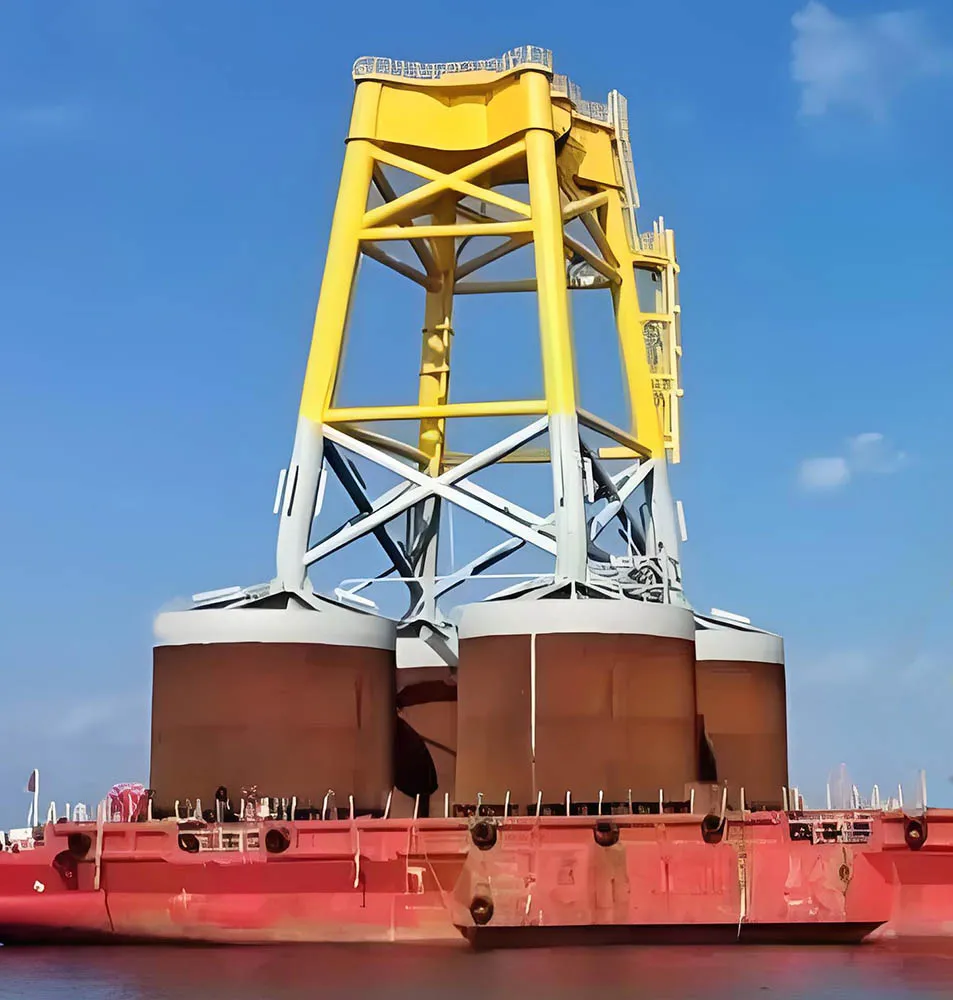
Product Overview
Structural Design and Load Capacity
Sea fastening and transport frames from Leading Top Union (领拓互联) are engineered to secure heavy offshore components during marine transit, with a maximum component weight capacity of 2,000 tons per frame. Fabricated from S355J2 or S355NL structural steel, these frames are designed to withstand dynamic loads encountered in open-sea transport, including 6-degree roll, 3-degree pitch, and 2g vertical acceleration as specified by DNV-GL-ST-N001. Each frame undergoes finite element analysis (FEA) to verify structural integrity under combined static and fatigue loading, ensuring compliance with Class 1 offshore container standards. The integration of high-strength bolts in Grade 10.9 or 12.9, paired with corrosion-resistant stoppers and guides, provides a secure interface between the cargo and vessel deck without relying on welding or permanent modifications.
The design process begins with a detailed assessment of the vessel deck configuration, including stiffener spacing, deck plate thickness, and allowable point loads per IACS UR S11. Leading Top Union engineers calculate required weld throat thicknesses for seafastening brackets using AWS D1.1 structural welding code, typically specifying 8 mm to 12 mm fillet welds for S355J2 material. For reusable transport frames, quick-release mechanisms are integrated to reduce offshore installation and removal time by up to 40% compared to conventional welded seafastening. These mechanisms employ tapered pins and hydraulic actuators capable of releasing under 50-ton preload, allowing rapid turnaround during offshore lifting operations in sea states up to DP2 conditions.
Material Selection and Corrosion Protection
Material selection for sea fastening frames prioritizes low-temperature toughness, with S355NL offering Charpy V-notch impact values of 27 J at -50°C per EN 10025-3. This ensures reliable performance in arctic offshore wind installations and North Sea oil and gas projects where ambient temperatures drop to -20°C. Surface treatment consists of a shop primer applied at 25 microns dry film thickness, followed by a marine-grade epoxy paint system achieving 320 microns total DFT per ISO 12944-5 C5-M corrosion category. Bolt preload is controlled to 70% of minimum yield strength using calibrated torque wrenches, with final tension verified by ultrasonic extensometers to ensure clamping forces remain within ±5% tolerance over the transport duration.
Structural Analysis and Quality Assurance
Structural analysis per DNV-GL-ST-N001 includes linear static, buckling, and fatigue assessments using a 1.35 safety factor for ultimate limit state and 1.0 for accidental limit state. For transport frames carrying components like wind turbine transition pieces weighing 800 tons, the analysis accounts for 100-year return period wave heights of 12 meters and significant wave periods of 8 seconds. Grillage beams are sized with a maximum deflection of L/400 under combined dead and live loads, while seafastening brackets are designed for a 1.5 factor of safety against slip at the steel-to-steel interface. All welds are inspected to 100% magnetic particle testing (MT) per ASTM E1444 and 10% ultrasonic testing (UT) per ASTM E164 for critical load paths.
Transport frames incorporate modular design principles, allowing disassembly into sections no larger than 12 meters by 3 meters for containerized shipping to remote project sites. Each frame includes clearly marked lifting points with a design factor of 4:1 for rigging attachments, per ASME B30.20 below-the-hook lifting devices. The integration of load cells at support points provides real-time monitoring of cargo weight distribution during loading, with data logged at 1 Hz frequency for post-transport analysis. This data-driven approach enables optimization of ballast plans and reduces the risk of overstressing vessel deck structures during heavy lift operations in ports with limited quay crane capacity.
Applications & Industries
Offshore Wind Energy Transport Solutions
In the offshore wind energy sector, sea fastening frames are critical for transporting monopile foundations weighing up to 1,500 tons and lengths exceeding 80 meters from fabrication yards in China to installation sites in the North Sea and Taiwan Strait. Leading Top Union has delivered frames for projects requiring 12-point support systems with adjustable saddles to accommodate taper angles of 1:100 on monopile sections. These frames incorporate DNV-GL-ST-N001 compliant seafastening with bolted connections rated for 200 kN per bolt, enabling secure transport in sea states with significant wave heights up to 4.5 meters. The reusable design allows up to 20 transport cycles before mandatory refurbishment, reducing per-turbine logistics costs by approximately 35% compared to single-use grillage systems.
Oil and Gas Subsea Equipment Transport
Oil and gas operators utilize custom sea fastening frames for subsea manifolds, templates, and pipeline end terminations (PLETs) weighing between 200 and 800 tons. These frames are designed to interface with specific vessel deck layouts, including barge configurations with 1.5-meter transverse stiffener spacing and 2.0-meter longitudinal spacing. For a recent Gulf of Mexico project, Leading Top Union fabricated frames with integrated mudmat supports and guide posts for subsea installation, achieving a 50-ton lift capacity per padeye with a 3:1 design factor per API RP 2A-WSD. The frames included sacrificial anodes with a 20-year design life per DNV-RP-B401, protecting the structure in cathodic protection systems during subsea deployment.
Mining and Mineral Processing Applications
Mining and mineral processing projects require transport frames for large grinding mills, crushers, and flotation cells with component weights up to 1,200 tons. These frames are engineered for overland transport on multi-axle trailers before marine shipment, requiring stiffness to maintain component alignment within ±2 mm over 30-meter lengths. Leading Top Union designs frames with integrated twist-lock systems compatible with standard flatbed trailers, reducing loading time by 60% compared to chain-and-binder methods. For a copper mine expansion in Chile, frames were supplied with corrosion protection rated for ISO 12944-5 C4 environments, including a zinc-rich primer applied at 50 microns and a polyurethane topcoat at 80 microns, ensuring durability during 6-month transport cycles through coastal and high-altitude routes.
Power Generation and Shipbuilding Equipment Transport
Power generation equipment, including gas turbine modules and steam turbine rotors, demands precision sea fastening to prevent rotor bowing or bearing damage during ocean transit. Frames for these applications incorporate vibration damping mounts with natural frequencies below 5 Hz to isolate cargo from vessel hull vibration at typical engine RPM ranges. Leading Top Union has supplied frames for 400-ton gas turbine packages with 16-point support systems, each point rated for 30 tons with ±0.5 mm height adjustability using threaded jacks. The frames are designed to maintain component alignment within 0.1 mm per meter under 1.5g dynamic loads, verified by laser tracking during load testing at the fabrication facility in Suzhou.
Shipbuilding and offshore construction vessels utilize transport frames for outfitting modules, accommodation units, and pipe racks weighing up to 600 tons. These frames are designed for rapid deployment using quick-release mechanisms that allow deck crew to secure or release cargo in under 30 minutes without hot work. For a recent FPSO topside integration project, Leading Top Union fabricated 12 reusable frames with integrated sea fastening bolts in Grade 12.9, each bolt torqued to 1,200 Nm with a ±3% tolerance using hydraulic torque wrenches. The frames included color-coded load indicators and inspection ports for visual verification of bolt tension, complying with DNV-GL-OS-E101 for offshore lifting and transport equipment.
Why Choose Leading Top Union for Sea Fastening & Transport Frames
Certifications and Quality Management
Leading Top Union holds ISO 3834-2 certification for fusion welding of metallic materials, ensuring all seafastening frames are fabricated under a quality management system audited to the highest European standard for welded construction. Welding procedures are qualified to EN ISO 15614-1 for S355J2 and S355NL materials, with welders certified to EN 287-1 for all positions. This certification base, combined with EN 1090-2 EXC3 execution class, guarantees traceability from raw material mill certificates to final inspection reports, meeting the documentation requirements of major EPC contractors in oil and gas, offshore wind, and mining sectors. The Suzhou facility operates with 12 CNC plasma cutting machines capable of processing plate thicknesses up to 100 mm with ±0.5 mm tolerance per ISO 9013.
Engineering and Documentation Excellence
The engineering team applies DNV-GL-ST-N001 and DNV-GL-OS-E101 standards from initial concept through detailed design, with all structural calculations independently verified by third-party classification society surveyors. Complete documentation packages are provided including FEA reports with von Mises stress plots, buckling analysis with load factors, and fatigue life assessments per S-N curves from DNV-RP-C203. For each frame, a transport manual is delivered specifying maximum allowable sea states, ballast requirements, and inspection intervals, enabling safe operation by vessel crews without specialized engineering support. The design-to-delivery timeline for custom sea fastening frames ranges from 8 to 16 weeks, depending on complexity, with expedited options for emergency replacement frames.
Delivery and Quality Control Processes
Ex-works delivery from Suzhou is offered with FOB port options from Shanghai or Ningbo, providing flexibility for international projects with tight schedules. Quality control includes 100% dimensional inspection using FARO laser trackers with ±0.025 mm accuracy, verifying all interface dimensions against approved drawings. Load testing is performed at 1.25 times the design load using calibrated hydraulic jacks and load cells, with deflection measured at 20 points per frame to validate FEA predictions. All test data is recorded in a digital quality dossier accessible to clients via secure portal, supporting audit requirements for projects under EN 1090-2 EXC3 and AWS D1.1 certification scopes.
After-Sales Support and Lifecycle Services
After-sales support includes on-site supervision during first use, with engineers available for installation at ports in Rotterdam, Houston, Singapore, and Abu Dhabi within 48 hours notice. A spare parts inventory is maintained for quick-release mechanisms, bolts, and stoppers, with typical lead times of 5 working days for standard components. For reusable frames, refurbishment services are offered including ultrasonic thickness measurement, bolt replacement, and recoating to original specifications, extending frame service life beyond 15 years. This lifecycle approach reduces total cost of ownership for transport frames by up to 40% compared to single-use alternatives, as verified by clients in the offshore wind and oil and gas sectors.