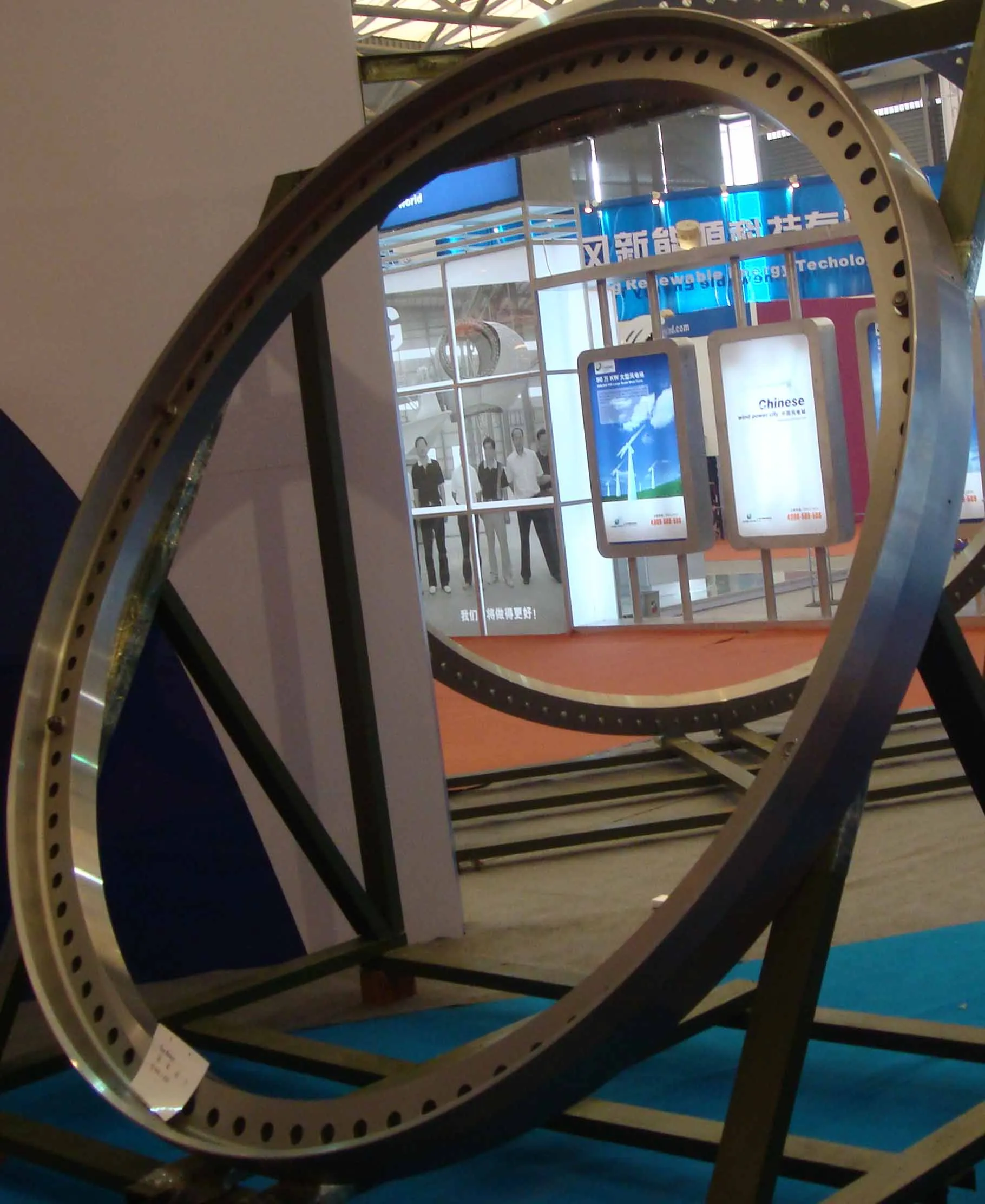
Product Overview
Wind tower flange machining requires precision that directly impacts the structural integrity and fatigue life of multi-megawatt turbines. Vertical lathes with an 8,000mm swing diameter at our Suzhou facility enable machining of flanges up to 7,000mm in diameter for onshore and offshore wind towers. Forged rings in S355NL and S420NL grades per EN 10025-3 are processed in normalized or quenched and tempered conditions to meet DNV-GL and IEC 61400-6 requirements. CNC machining centers achieve bolt hole positional accuracy of ±0.2mm across the full flange circumference, critical for maintaining tower section alignment under cyclic loading conditions exceeding 10⁷ load cycles over a 20-year design life. For extreme wind classes, flanges are designed to withstand ultimate loads of 8,000-12,000 kN-m bending moment at the tower base, with bolt preloads of 70-80% of yield strength per EN 1993-1-8.
The machining sequence begins with rough turning on vertical boring mills, removing 3-5mm of stock per pass while maintaining concentricity within 0.3mm TIR. Finish turning of the flange face achieves flatness ≤0.5mm measured across any 1,000mm chord length, verified with laser interferometry per ISO 1101. Surface finish on the flange face is held to Ra 6.3μm maximum, with the sealing groove achieving Ra 3.2μm to ensure reliable gasket compression for bolted connections. Bolt holes ranging from M36 to M72 are drilled using CNC carbide indexable tooling at spindle speeds of 600-1,200 RPM, followed by counter-boring to depths specified by tower design standards such as EN 1993-1-8 or AISC 360-16. For offshore applications, hole configurations accommodate 48-96 bolts per flange, with angular spacing held within ±0.02° to ensure uniform load distribution.
Quality control includes 100% dimensional inspection using coordinate measuring machines (CMM) with accuracy traceable to NIST standards. Bolt hole position is measured using a rotary table with 0.001° resolution, verifying pitch circle diameter (PCD) tolerance of ±0.5mm and hole-to-hole angular spacing within ±0.02°. Flange parallelism is checked with electronic levels achieving 0.01mm/m resolution, ensuring the top and bottom faces remain parallel within 0.3mm total variation. For material verification, ultrasonic testing per EN 10160 for laminations and inclusions is conducted, with acceptance criteria of Class S2 for flange rings. Each flange receives a unique serial number with full traceability to mill certificates and machining records. Statistical process control (SPC) with CpK targets ≥1.67 for critical dimensions is implemented for serial production, reducing inspection time and ensuring first-pass yield above 98%.
Applications & Industries
Wind tower flange machining serves the foundation of modern wind energy infrastructure, with components installed in towers ranging from 80m to 160m hub height. For onshore wind farms in Class II and III wind zones, flanges are machined for tubular steel towers supporting 2-6MW turbines, where flange diameters typically range from 3,500mm to 5,500mm. These flanges must withstand ultimate loads of 8,000-12,000 kN-m bending moment at the tower base, with bolt preloads of 70-80% of yield strength per EN 1993-1-8. S355NL flanges with 120-180mm wall thickness provide the necessary stiffness while maintaining weight efficiency for transport logistics, with each flange typically weighing 3-8 metric tons depending on tower section. For high-wind Class I sites, S420NL grades with enhanced yield strength of 420 MPa are specified, requiring careful control of welding heat input to maintain HAZ toughness.
Offshore wind applications demand enhanced corrosion resistance and fatigue performance, where flanges are machined for monopile transition pieces and jacket foundation towers. These components operate in marine environments with splash zone temperatures ranging from -20°C to +40°C, requiring material toughness of ≥27J at -40°C per EN 10025-3 for S420NL grades. Machining processes accommodate flanges with integrated J-tube supports and boat landing brackets, maintaining flatness within 0.5mm even with complex geometries. For offshore projects in the North Sea and Baltic Sea, flanges have been supplied for 8-15MW turbines with bolt hole patterns accommodating M64-M72 bolts in 48-96 hole configurations, achieving DNV-GL certification for fatigue design class F. Surface preparation for offshore flanges includes grit blasting to Sa 2.5 per ISO 8501-1, followed by zinc-rich primer application to DFT 80-120μm per ISO 12944 C5-M for corrosion protection in aggressive marine atmospheres.
Beyond wind energy, flange machining capabilities support heavy industrial applications requiring large-diameter precision connections. Petrochemical and refining industries use these flanges for reactor vessels and heat exchangers operating at pressures up to 200 bar and temperatures from -50°C to +400°C, where flange face flatness of 0.5mm ensures leak-tight joints per ASME PCC-1. Mining and mineral processing facilities specify these flanges for grinding mill trunnions and slurry pipeline connections, with bolt hole accuracy of ±0.2mm enabling rapid field assembly in remote locations. Power generation plants, including concentrated solar power (CSP) and geothermal facilities, utilize these flanges for steam turbine casings and heat recovery steam generators (HRSG), where surface finish Ra 6.3μm minimizes fugitive emissions under cyclic thermal loading. For nuclear power applications, additional NDT requirements per ASME Section III are met, including magnetic particle testing of all machined surfaces to detect surface discontinuities down to 0.5mm length.
Why Choose Leading Top Union for Wind Tower Flange Machining
ISO 3834-2 welding certification combined with AWS D1.1 and EN 1090-2 EXC3 execution class ensures flange machining integrates seamlessly with full tower fabrication. Our Suzhou facility operates 24/7 with 15 CNC vertical lathes and 8 horizontal boring mills, providing capacity to machine 200+ flanges per month for projects requiring JIT delivery. In-house heat treatment furnaces capable of stress relieving flanges up to 8m diameter at 580-620°C reduce residual stresses from forging and machining to below 30% of yield strength. This integrated approach eliminates logistics delays and ensures consistent quality across all tower sections, with typical lead times of 4-6 weeks from raw material receipt to finished flange shipment. For emergency replacement projects, rush orders can be completed within 3 weeks using pre-stocked forged rings in common sizes.
Engineering support for flange design optimization includes finite element analysis (FEA) for bolt load distribution and fatigue life prediction per IEC 61400-6. Bolt hole patterns are optimized for reduced stress concentrations, achieving S-N curve improvements of 15-20% compared to standard configurations. For projects requiring special materials, forged rings are sourced from approved mills with PED 2014/68/EU certification, maintaining stock of S355NL and S420NL in common sizes from 3,000mm to 7,000mm diameter. The quality management system includes regular audits by DNV-GL, TÜV SÜD, and Bureau Veritas, with all flanges supplied with EN 10204 Type 3.2 inspection certificates when required. For critical offshore projects, additional third-party witness testing of mechanical properties and NDT is coordinated to meet client-specific requirements.
Value-added services include protective coating application with zinc-rich primers to DFT 80-120μm per ISO 12944 C5-M for offshore environments, and machined surface preservation with VCI paper for export shipments. Logistics coordination with freight forwarders for breakbulk and containerized shipping from Shanghai and Ningbo ports covers delivery to wind farms in Europe, Southeast Asia, Australia, and South America. Statistical process control (SPC) with CpK targets ≥1.67 for critical dimensions is implemented for serial production, reducing inspection time and ensuring first-pass yield above 98%. For flange diameters exceeding 5,000mm, specialized transport frames with shock-absorbing mounts are provided to prevent distortion during transit. Contact our technical sales team at info@leadingtopunion.com or +86-512-XXXX-XXXX to discuss your flange machining requirements with dimensional drawings and material specifications.